Business Intelligence vs Decision Intelligence: What Is the Difference?
Business Intelligence vs Decision Intelligence is the difference between seeing performance and deciding how to improve it.
Business Intelligence helps teams see what happened. Decision Intelligence connects that insight with business context, rules, ownership and execution, so organisations can decide what to do next, act within clear boundaries and measure the result.
Most finance teams do not lack information. They struggle with decision latency.
A dashboard shows that margin fell in one region. Inventory is rising, and conversion is slowing. The insight is useful, but it does not resolve the decision. Teams still need to understand the cause, compare options, agree on ownership and coordinate action.
Meetings follow. Spreadsheets multiply. Meanwhile, the opportunity to protect cash, margin or service levels begins to disappear.
Business Intelligence vs Decision Intelligence
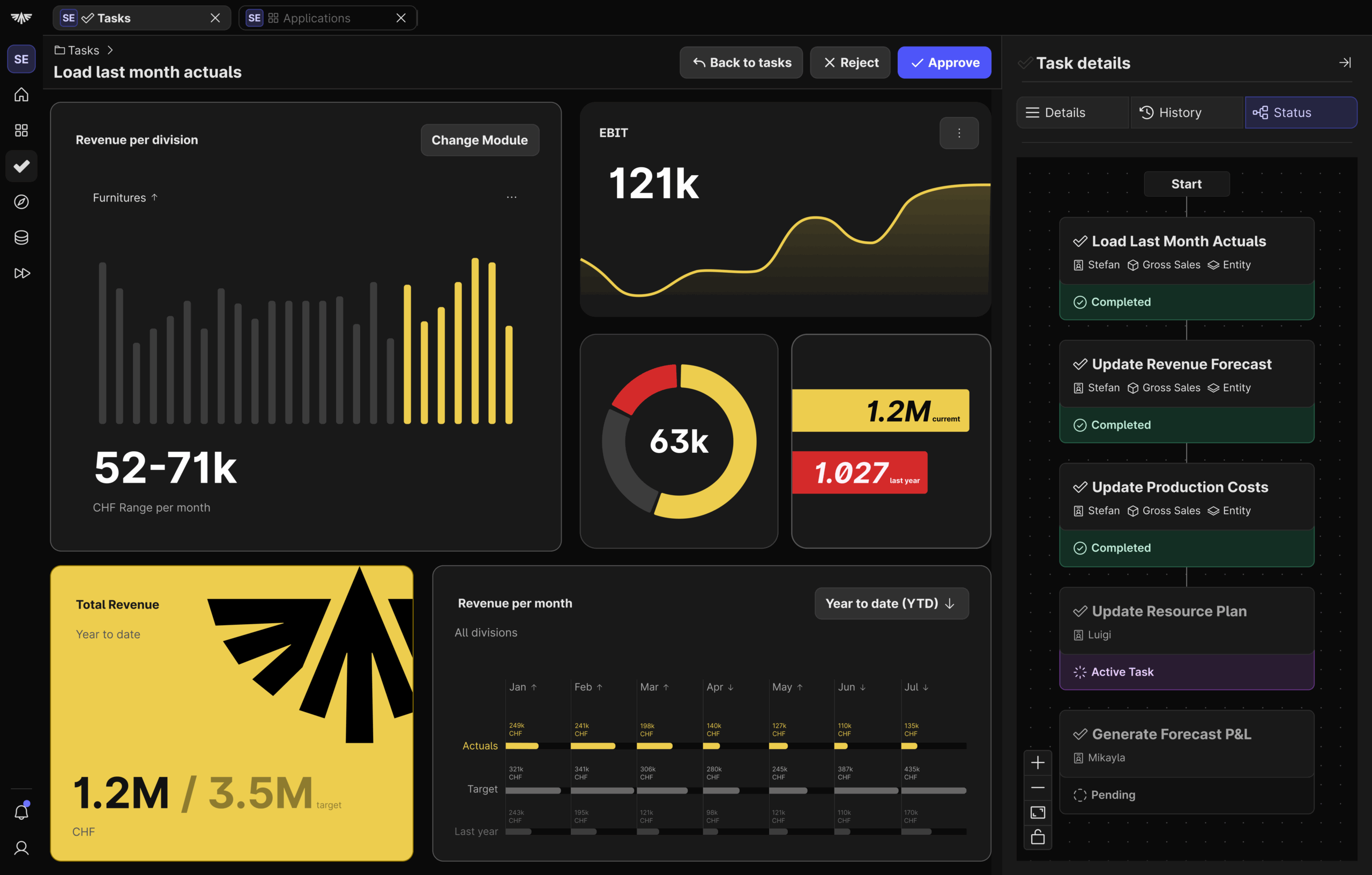
Business Intelligence is designed to analyse and communicate performance. It consolidates data, tracks KPIs and helps teams identify trends or exceptions.
However, the work often continues outside the BI platform. People must interpret the issue, agree on assumptions, assess trade-offs and decide who should act. The logic may sit in spreadsheets, while approvals and follow-ups move through email.
Decision Intelligence starts from the decision itself.
It defines what must be decided, by whom, how often and with what expected impact. It then connects the data, KPIs, business rules, constraints, analytical models and workflows required to make that decision well.
BI provides visibility. DI turns visibility into governed decision-making and action.
What Decision Intelligence Adds
Decision Intelligence makes important decisions explicit, repeatable and measurable.
First, it creates a shared decision context. This includes relevant data, business entities, KPI definitions, hierarchies, policies, thresholds and operating rules. It also includes the current situation: live KPI values, available resources, open approvals, exceptions and workflow status.
This combination helps the organisation understand more than what happened. It shows why the situation matters, where the decision currently stands and which action paths are valid.
Second, Decision Intelligence compares alternatives. Teams can run scenarios, assess expected outcomes and quantify trade-offs across margin, cash, capacity, service and risk.
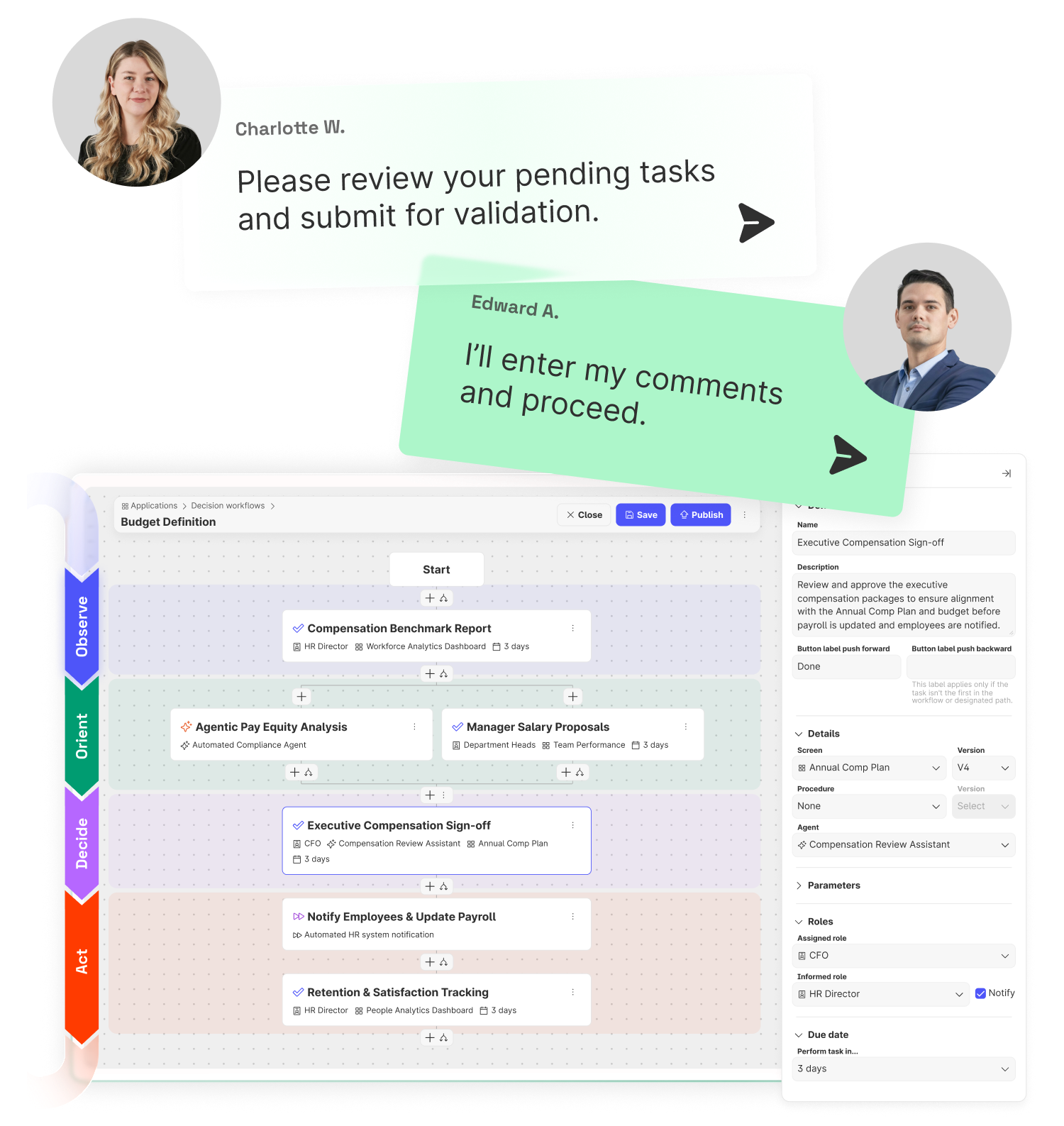
Third, it orchestrates execution. The selected action can trigger tasks, approval requests, notifications, write-back or integrations with operational systems.
Finally, it creates a record of the decision. The organisation can retain the evidence, recommendation, approval, action and outcome. This supports governance and provides the foundation for monitoring decision performance over time.
How Natzka Operationalises Decision Intelligence
Natzka is a Decision Intelligence platform built to reduce decision latency and improve decision quality.
It brings together capabilities that organisations often buy and manage separately: data and decision context, analysis and simulations, workflow orchestration, governance and AI.
One Shared Decision Context
Natzka connects fragmented data, KPIs and business logic in one trusted environment.
The platform understands entities and relationships as the business uses them. These may include customers, products, channels, geographies, legal entities, cost centres and operational assets.
It also connects this engineered context with the live decision state. Sensors can detect threshold changes, anomalies, events and predicted risks. Each signal can be linked to its source, timestamp and relevant workflow.
As a result, users and AI can work with current, traceable business context rather than isolated data points.
Reusable Decision Services
Recurring decisions should not be rebuilt every time they occur.
Natzka combines reusable platform components, enterprise definitions and decision-specific workflows. Data models, calculations, dashboards, scenarios, permissions, tasks and approvals can become shared building blocks.
At the operational level, these elements form a decision service. It brings together the context, analysis, rules, approval path and actions required for a recurring decision.
For example, an inventory decision service may detect a potential shortage, compare allocations, estimate service and margin effects, request approval and send the selected action to the relevant system.
These structured services turn recurring activities into governed decision workflows with clear ownership, rules and action paths.
Governed Agentic AI
AI creates enterprise value when it operates inside a defined decision process.
Natzka’s approach to Agentic Decision Intelligence connects AI with decision context, business logic and governed execution.
Natzka AI can detect a business signal, interpret it using decision context, compare alternatives and recommend an appropriate action path. It can then initiate a modelled workflow, create tasks, request approvals or call approved services.
The AI does not invent unrestricted operational processes. It acts through defined rules, permissions and workflows.
The level of delegation can vary. AI may support a person, execute after human approval or automate selected decisions when the logic and risk controls are mature enough.
Governance Before, During and After the Decision
Decision governance is not limited to an audit log.
Before the decision, the organisation defines ownership, roles, approved rules, thresholds and AI autonomy boundaries.
During the decision, Natzka applies those controls. It can route approvals, manage exceptions and record overrides with their rationale.
Afterwards, the organisation can reconstruct the evidence, KPI lineage, rule or model version, approvals and actions associated with the outcome.
This makes decisions more accountable without separating governance from execution.
Where the Business Value Appears
Decision Intelligence creates value in areas CFOs and business leaders already measure.
Decision cycles become shorter, reducing the cost of delay when demand, supply or prices change. Inventory decisions can balance service levels with working capital. Pricing and mix choices can account for cost, elasticity and rebate exposure in the same process.
Governed workflows also reduce manual coordination. Teams spend less time reconciling assumptions, chasing approvals or reconstructing why a decision was made.
Over time, decision records can reveal recurring overrides, workflow bottlenecks, obsolete rules or differences between expected and actual outcomes. These signals help organisations identify where decision processes need attention.
Business Intelligence and Decision Intelligence Work Together
The practical answer to Business Intelligence vs Decision Intelligence is not choosing one over the other, but understanding the distinct role each plays.
Business Intelligence remains essential for measuring and communicating performance. Decision Intelligence extends that value by structuring the decisions that change performance.
Use BI to understand the business. Use DI to decide, govern and act.
Natzka combines both perspectives in one environment. Teams can analyse results, model alternatives, manage workflows and connect approved decisions with execution.
A Practical First Step
Start with one decision that is frequent, financially relevant and cross-functional.
Define its owner, expected impact, drivers, rules and constraints. Connect the minimum data required to evaluate it. Then compare options, approve an action and measure the outcome.
As the process becomes faster and more reliable, reuse the same context and services across adjacent decisions.
Ultimately, Business Intelligence vs Decision Intelligence is the difference between seeing performance and creating a governed process to improve it.
Ready to reduce decision latency and improve decision quality? Contact Natzka to identify your first high-value decision workflow and turn better decisions into measurable impact.