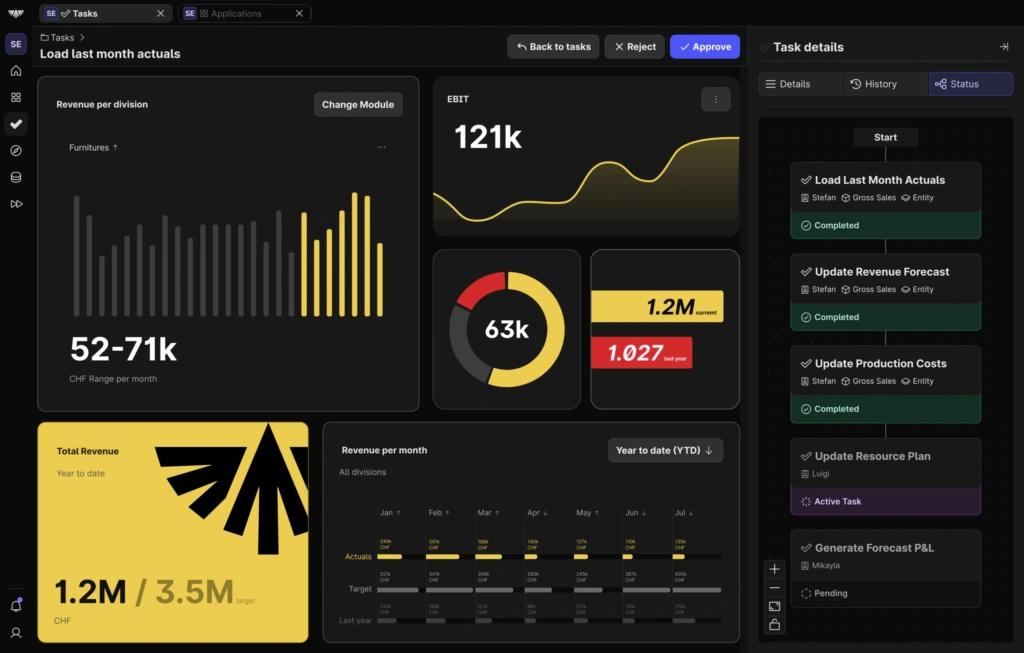
AI is becoming the easiest way to access data, analytics, scenarios, and business workflows. But useful enterprise AI needs more than a conversational interface. In a conversation with Actually Podcast, Natzka CEO Matteo Emiliani explains why AI is the enabler and why Agentic Decision Intelligence provides the foundations that make it perform.
Matteo Emiliani joined Actually Podcast to discuss the real impact of AI on companies, professional roles, and enterprise decision-making.
Listen to the Podcast on Spotify, Apple Podcasts or YouTube
Curious about Natzka? Contact us
Executive Summary
- AI can become the simplest way to access enterprise capabilities. People can ask what changed, understand why, compare options, and start the next action.
- An interface alone is not enough. AI needs trusted data, shared business logic, explicit workflows, and clear accountability.
- Not every decision belongs in automation. Autonomy should be determined by the importance, risk, and repeatability of each decision.
- Professional roles will change. Teams will spend less time collecting information and more time interpreting it, advising the business, and acting on it.
- The real opportunity is not to add more AI tools. It is to redesign how decisions move from information to coordinated action.
The central message is simple. AI may be the interface. Agentic Decision Intelligence makes its answers useful, trusted, and actionable.
Is AI really transforming Companies?
The public conversation around artificial intelligence moves quickly. Every week brings another model, agent, assistant, or enterprise AI announcement. From the outside, it looks as if autonomous agents already work as ordinary members of the workforce, researching information, preparing analysis, and taking action on behalf of employees.
Inside many organisations, the reality remains less advanced. Data sits across ERP systems, business applications, documents, and spreadsheets. Decisions still happen in recurring meetings. Teams still spend time determining which number is correct, who owns the next step, and whether anyone has actually completed an approved action.
As a result, a wide gap separates AI ambition from organisational readiness.
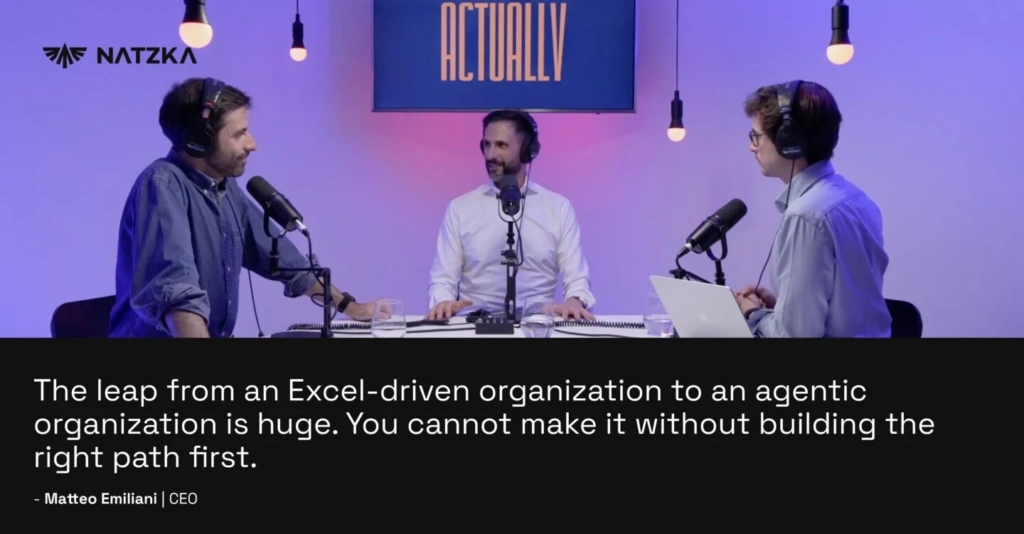
This does not mean companies should wait before adopting AI. Instead, they need to understand what AI should access, support, and improve. This is the gap Agentic Decision Intelligence exists to close.
AI is the enabler
AI is changing how people interact with enterprise software. Instead of navigating several applications, opening reports, and manually reconstructing the business context, a user can increasingly begin with a question. What changed, and why? Which variables drive the result? What options do we have, what would happen under each scenario, and which action should follow?
This is a fundamental change in the experience of enterprise technology. AI can make advanced data, analytics, and planning capabilities easier to access by shortening the distance between a business question and the information needed to answer it.
But access is only the beginning. A credible answer still depends on the underlying structure. It requires reliable data, shared definitions, business logic, and analytical models. It equally requires roles and permissions, decision ownership, approval paths, governed workflows, and a record of actions and outcomes. Without these foundations, an AI assistant may generate an answer without understanding how the organisation actually works or what should happen next.
This is why we do not treat AI as an isolated feature bolted onto an enterprise platform. AI is the enabler that enables people to access the broader capabilities of Natzka. Agentic Decision Intelligence provides the context and the operating structure that make those interactions reliable.
What is Decision Intelligence?
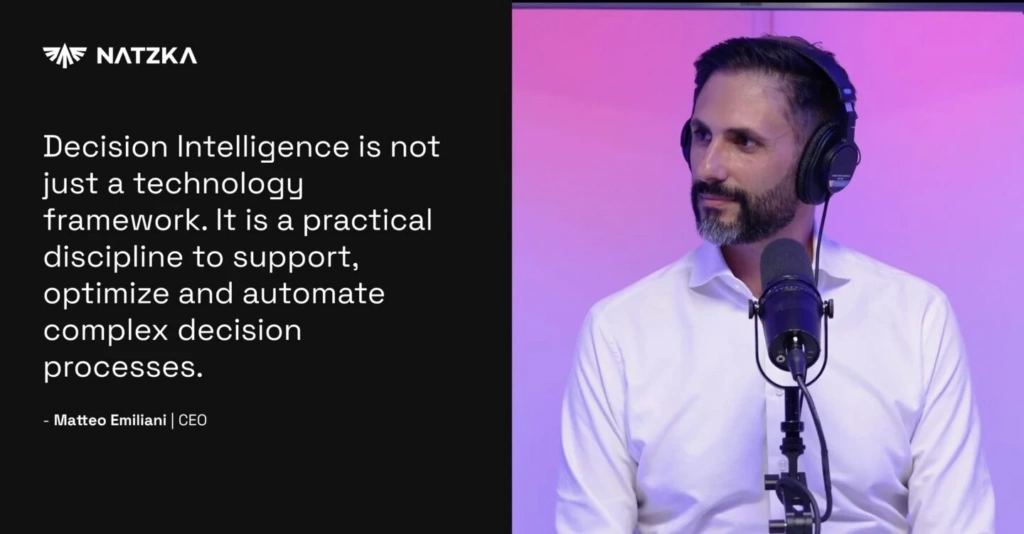
Decision Intelligence helps organisations improve how they make, govern, execute, and evaluate decisions. It brings together elements that usually sit in separate systems and departments: business data, analytical and predictive models, human expertise, business rules, scenarios and constraints, decision ownership, workflows, AI assistance, and outcome measurement.
The objective is not simply to produce another recommendation. It is to make the decision explicit. What question needs an answer, and who owns the decision? Which information matters, which rules apply, and which options are available? Which steps need human approval, what action follows, and how will the organisation measure the result?
Once these elements are clear, AI can support the decision safely and usefully.
Which decisions should AI make?
Where’s the boundary between human and machine decision-making? The useful question is not simply whether AI can make a decision, is whether AI should make it, under which conditions, and who remains accountable.
We approach this through three levels of Decision Intelligence.
Decision support
For strategic, ambiguous, or high-impact decisions, AI helps people understand the situation. It can aggregate information, detect patterns, explain changes, identify risks, and present relevant options, while the decision itself remains human-led. Think of entering a new market, changing corporate strategy, making a significant capital investment, restructuring an organisation, or revising a major pricing policy. These decisions involve judgment, values, and consequences that no single calculation can capture.
Decision augmentation
At the next level, AI becomes a more active decision partner. It can compare scenarios, evaluate trade-offs, recommend actions, and prepare the corresponding workflow, while the responsible person reviews the recommendation and retains accountability.
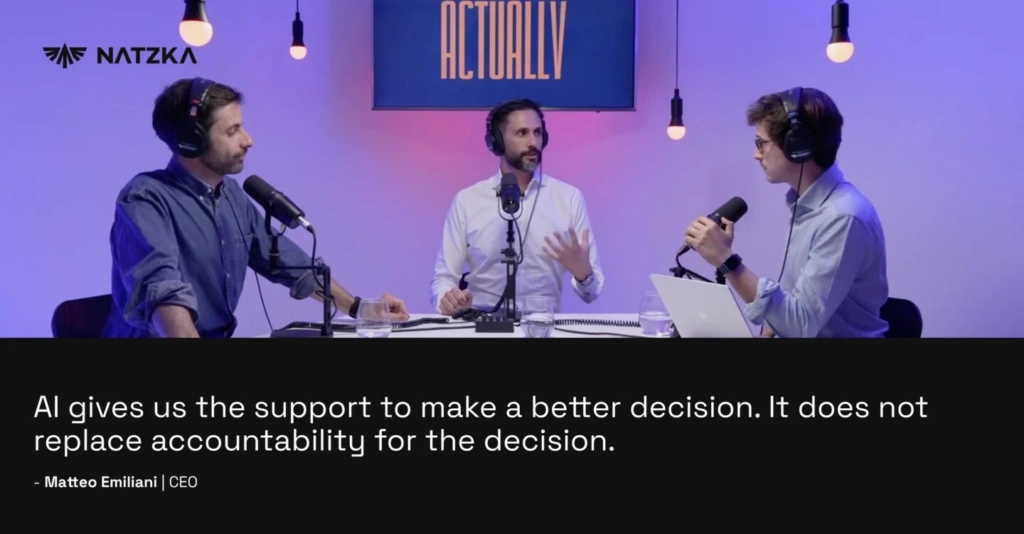
For many enterprise decisions, augmentation offers the right balance. AI brings speed, scale, and the capacity to analyse more information. Humans contribute contextual judgment, responsibility, and an understanding of consequences that the data may not fully represent.
Decision automation
Routine, repeatable, and lower-risk decisions can move step by step toward delegation. For example, an agent might route an exception to the correct owner or trigger a replenishment workflow within approved limits. It could equally flag an unusual financial movement, reallocate a resource within defined thresholds, or launch an established maintenance procedure. In these situations, the business has already defined the objective, rules, limits, and escalation paths. The agent is not inventing policy. It operates within a policy defined by the organisation.
Autonomy should follow risk
The appropriate level of autonomy depends on strategic importance, financial and operational impact, frequency, reversibility, and regulatory sensitivity. It also depends on the quality of the available data, the confidence in the underlying rules, and the clarity of accountability. The higher the uncertainty and the potential impact, the stronger the role of human judgment should remain.
How Agentic Decision Intelligence turns answers into action
A chatbot responds to a prompt. An enterprise agent carries a responsibility within a wider process. It might monitor an event, investigate an exception, compare possible actions, recommend a response, execute an approved task, or coordinate the next steps.
To do this well, the agent needs more than access to an LLM. It needs to understand the business objective, the organisational context, the trusted sources of information, and the rules that constrain the decision. It also needs to know who is involved, what actions are permitted, the conditions that require escalation, and the expected outcome.
This is where many AI initiatives hit the orchestration wall. The AI can generate an intelligent response, but the organisation has no reliable way to connect that response to ownership, governance, and execution. As a result, someone must still interpret the recommendation manually, transfer it to another system, and coordinate follow-up via email and meetings.
Agentic Decision Intelligence closes that gap by placing AI inside an explicit decision workflow.
The finance team of the future
“Fewer accountants, more controllers; fewer analysts, more business partners.”
The point is not that finance becomes less important. On the contrary, it becomes more strategically involved.
Today, many finance professionals spend significant time gathering data from different systems, correcting inconsistent definitions, and reconciling departmental numbers. They update spreadsheet models, prepare recurring reports, request explanations from colleagues, and track approvals through meetings and email. These activities compensate for fragmentation in the organisation. Once a company connects its data, business logic, and decision workflows, finance can spend less time preparing the context and more time helping the business decide what to do.
Financial data needs business context
Financial data has limited value in isolation. For example, a margin reduction may result from product mix, supplier costs, promotional activity, workforce capacity, logistics performance, or shifts in customer demand. Similarly, a working-capital issue may involve inventory policies, payment terms, production decisions, and sales forecasts.
The finance professional of the future, therefore, works across functions. Instead of only reporting that performance changed, finance can help answer what caused the change, whether it is temporary or structural, and which variables the company can influence. From there, the team can lay out the available options and what each one means for revenue, margin, cash, and risk. The team can then clarify who needs to act and how the organisation will measure the result.
This is the role of the finance business partner: someone who combines financial discipline with an understanding of the wider business.
From the pyramid to the diamond
The traditional company resembles a pyramid, with many junior roles at the bottom and fewer and fewer managers above them. As automation absorbs repetitive work, this structure may begin to resemble a diamond.
There may be fewer roles focused entirely on manual data preparation and coordination. At the same time, organisations will need more people who combine functional expertise, analytical understanding, business judgment, and the ability to work effectively with AI.
That shift raises a wider question for education and professional development. Companies cannot simply remove junior work without reconsidering how future professionals gain experience; job design, training, and career paths must evolve with technology. AI adoption is therefore not just a software initiative. It is an organisational transformation.
Why Natzka is not another dashboard
Is Natzka ultimately a large, more advanced dashboard?
“Absolutely not.”
The distinction matters because a dashboard normally stops where the decision begins. A dashboard can show that demand has increased, costs are rising, a project is behind schedule, or a forecast no longer holds. It helps the user see the problem. However, the organisation still needs to determine why it happened, which options exist, and what the trade-offs are. It also needs to decide who should approve, which action should follow, and who will coordinate execution.
That work often happens outside the dashboard, in spreadsheets, presentations, meetings, messages, and personal follow-ups.
“The dashboard gives you a glimpse of the past.”
Agentic Decision Intelligence extends the process beyond visibility by connecting observation to explanation, scenario evaluation, decision-making, and execution. A decision-centric platform can detect a signal, explain the underlying drivers, and compare possible responses. It can then assign ownership, apply approval rules, and launch the selected workflow. Finally, it records the decision and its rationale and measures the result, so that every outcome improves the next decision.
The dashboard remains useful. It is simply no longer the destination.
What Natzka is building
We built Natzka around a simple premise: information creates value only when it helps an organisation decide and act.
The platform brings together capabilities that usually sit fragmented across the enterprise. These include data from different sources, analytical models, scenarios and forecasts, business rules, and human responsibilities. They also include decision workflows, AI recommendations and agents, execution across teams and systems, and feedback from outcomes.
AI provides a more intuitive way to access these capabilities. A person can ask a question, understand what changed, compare the available options, and start the next action. Behind that experience, Natzka provides the shared context, decision logic, and governance that make the interaction trustworthy. This is Agentic Decision Intelligence in practice.
The result is not an autonomous organisation in which human expertise becomes irrelevant. It is a more decision-centric organisation, one where recurring decisions become explicit, coordinated, traceable, and measurable, and where people and AI contribute according to clearly defined roles.
“Our motto is: change the way decisions are made.”
The real impact of AI starts with the decision
The most important conclusion from the conversation is not that AI will eliminate a specific profession or replace a specific category of enterprise software. It is that AI gives organisations an opportunity to redesign work that has remained fragmented for decades.
Companies have accumulated data, applications, dashboards, and reports. Yet decisions still depend on individuals manually reconstructing context and coordinating action. AI can make enterprise capabilities easier to access. Agentic Decision Intelligence can make the results trustworthy, governed, and executable.
The organisations that lead will not necessarily be those deploying the greatest number of agents. They will be those who understand which decisions matter, deliberately design those decisions, and give people and AI a reliable way to act together.