Status meetings slow decisions and dilute accountability. Decision flows fix both. They compress cycle times, reduce risk, and make sure decisions happen when the numbers matter, not when calendars align.
Open your calendar. Next, count the blocks labelled “update,” “review,” or “check-in.” Then do the real math: a weekly 60-minute meeting with 10 managers consumes roughly 500 person-hours a year. That is the visible cost. The hidden cost is worse: decisions pushed to “next week,” stalled initiatives, and capital trapped in limbo because nobody made the right call when the signal appeared.
The weekly status ritual transfers information; it does not drive action. Teams present stale slides, debates meander, and the session closes with “let’s regroup.”
There is a better operating model: replace status meetings with structured, asynchronous decision flows. This is not a nicer meeting. Instead, it is a different system.
How decision flows work
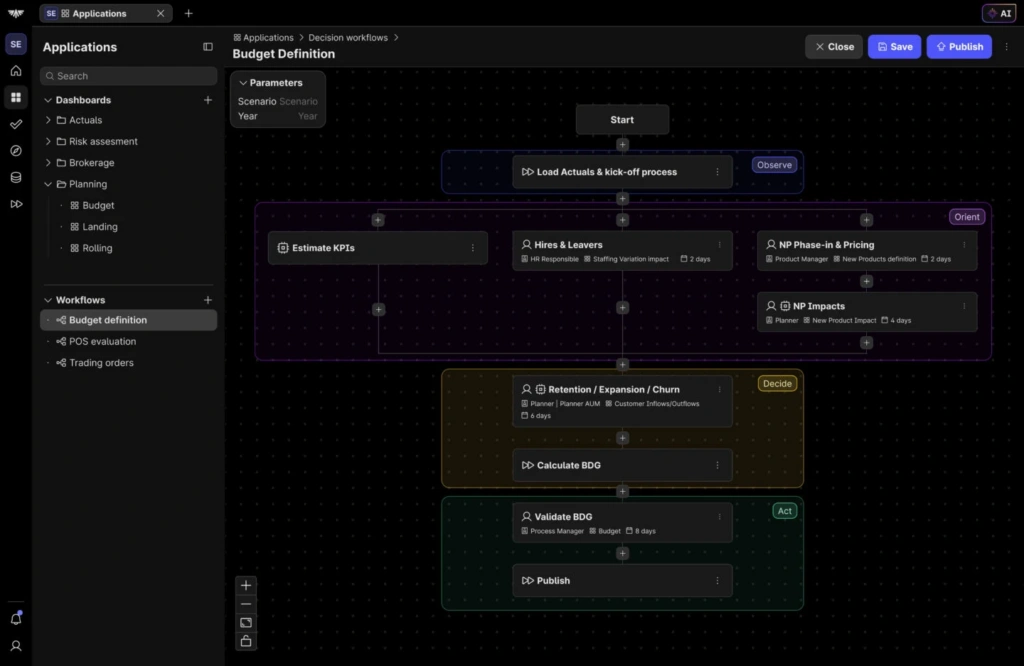
A decision flow breaks a clumsy all-hands into a disciplined process with three non-negotiables.
- Every material decision has a single accountable owner. Not a committee. One name is attached to driving the decision to a conclusion and owning the outcome.
- The owner frames a precise question with a clear threshold for success. “Should we move $250,000 from top-of-funnel brand to bottom-funnel promotion to hit the Q3 pipeline target?” is actionable. Vague topics are not.
- Input is time-boxed and structured. Stakeholders contribute their data, analysis, and recommendations within a defined window. No slide decks. No lost context. When the window closes, the owner decides, records the rationale, and the organisation moves.
What decision flows change for finance
Cycle times compress from months to a week because work happens in parallel rather than in a meeting queue. Explicit ownership also improves accountability and reduces rework. Moreover, the decision record creates an audit trail that reduces compliance risk and ends the “who said what” archaeology during quarter close or board prep.
Most importantly: teams make decisions when the numbers matter, not when calendars align.
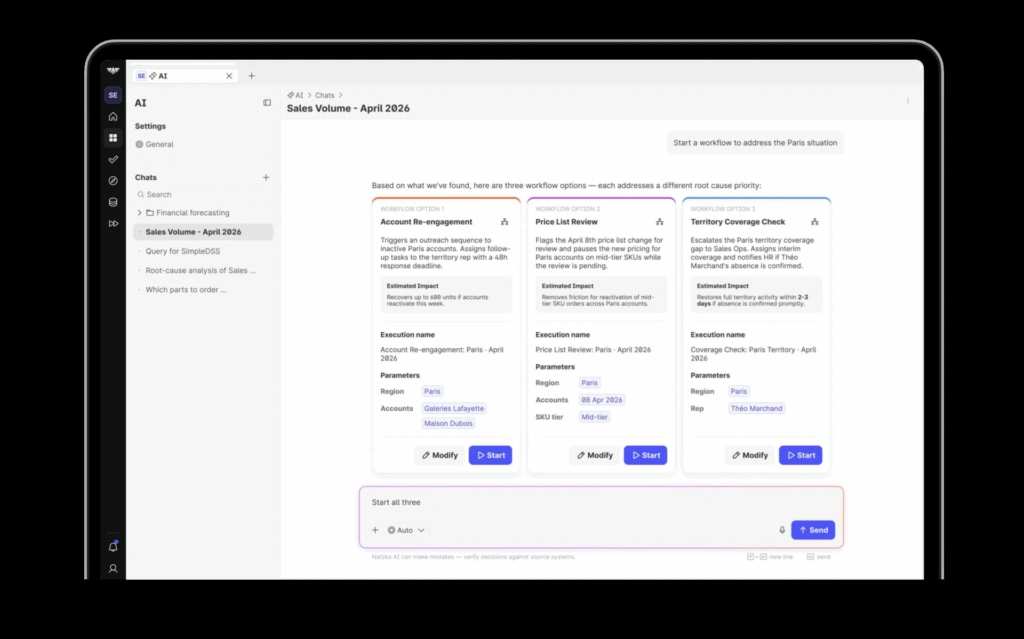
An end to end decision flow
A Decision Intelligence platform like Natzka serves as the system of record for all decisions.
In Natzka, a decision flow runs end-to-end. It is clear who is responsible, accountable, consulted, and informed. Simulations compare scenarios side by side, so trade-offs are explicit. In addition, approvals and constraints, such as spend limits and margin floors, are enforced by a workflow rather than memory. When the call is made, Natzka orchestrates follow-through: creating tasks, updating systems where appropriate, and tracking outcomes against the stated intent. The result is a permanent, searchable decision record that improves with every cycle.
Ownership stays visible, and RACI stays unambiguous. Natzka also preserves data lineage and versioning, so anyone can see which numbers drove the call. Furthermore, threshold-based alerts automatically trigger decision flows, so you can act on the alert rather than wait for a scheduled slot.
Start your first decision flow
Meetings transfer information. Decision flows create outcomes. In short, if your calendar is full, your operating model is telling you something.
Move the work where it belongs: into a system built to decide. Start now.