Decision Intelligence for Motorsport: Natzka and AF Corse at Politecnico di Milano
Which component needs attention? When should the team replace it? What evidence supports the call? And where must human judgment stay in control? These are recurring decisions that shape safety, performance, readiness and cost. They are also exactly what decision intelligence for motorsport exists to answer.
100+ cars · 10,000+ monitored components ·
~100 events per year · 80% automation · 90% faster reporting
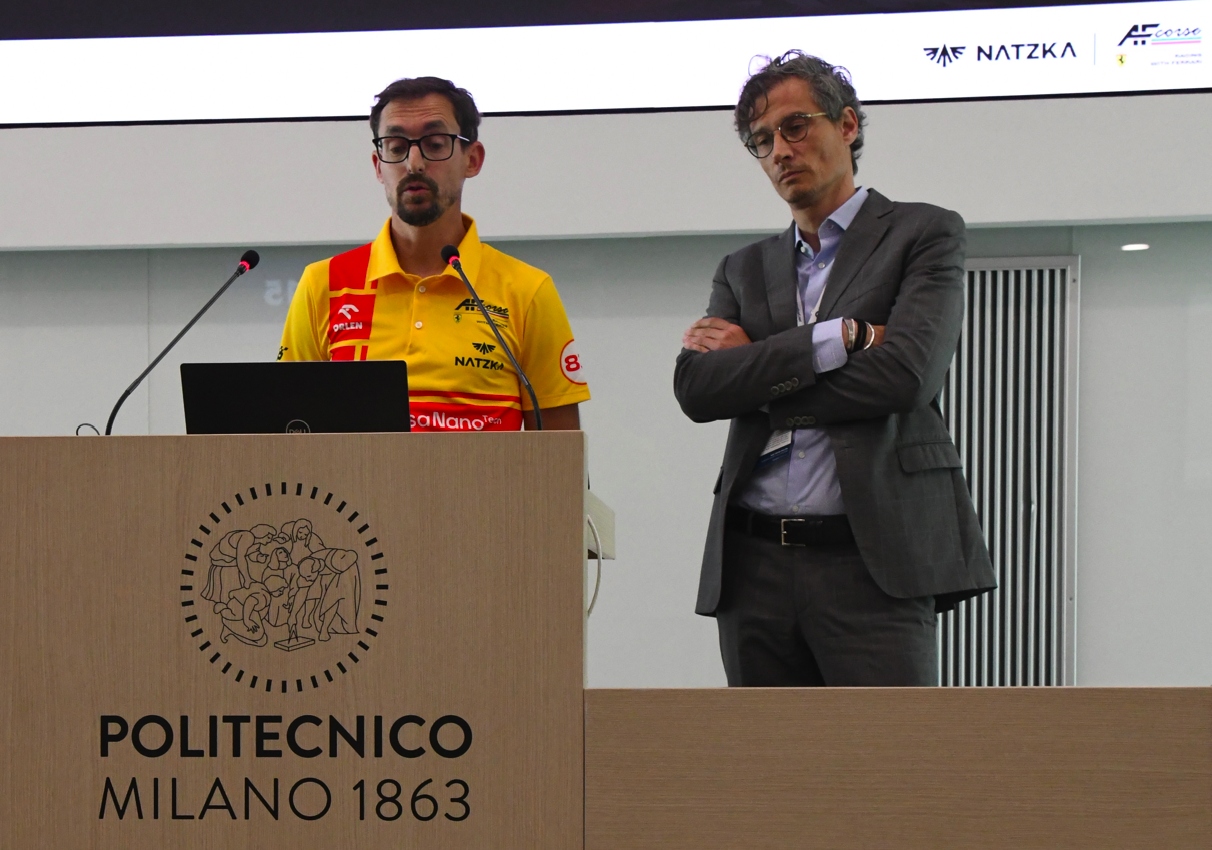
On June 18, 2026, AF Corse and Natzka brought those decisions to the Use Case Session of the Osservatorio Data & Decision Intelligence at Politecnico di Milano. In front of almost 1,000 participants in the room and on the livestream, AF Corse Team Manager Luca Corradini and our CPO Andrea Masiero presented the Lifing proactive monitoring project.
The session gave the audience a concrete example of decision intelligence in motorsport: telemetry, predictive models, workflows, and expert judgment operating as a single continuous decision system. Moreover, its relevance reaches far beyond racing. The project shows what happens when an organisation stops treating data as an output and starts organising it around the decisions people need to make.
A high-value decision, repeated thousands of times
The operational setting is the Ferrari 296 Challenge. The project covers 100 cars and more than 10,000 components grouped into 40 functional systems, across roughly 100 events worldwide and around 12,000 kilometres per car every year.
By industrial standards, the fleet is small. However, each component demands precision engineering and represents significant value. Replacing a part too early wastes money. Replacing it too late puts safety, performance and the driver experience at risk. Precision, therefore, matters more than scale.
Lifing means calculating the remaining useful life of each component. In practice, the system tells the team how many kilometres or operating hours remain before a part needs inspection or replacement.
Every recommendation balances three priorities. Safety comes first. Performance follows. The third is the experience of the gentleman drivers who compete in the championship. So the challenge is not only to estimate component life accurately. It is to turn that estimate into a timely, explainable and executable decision. That is the core job of decision intelligence for motorsport.
How decision intelligence for motorsport connects one race to the next
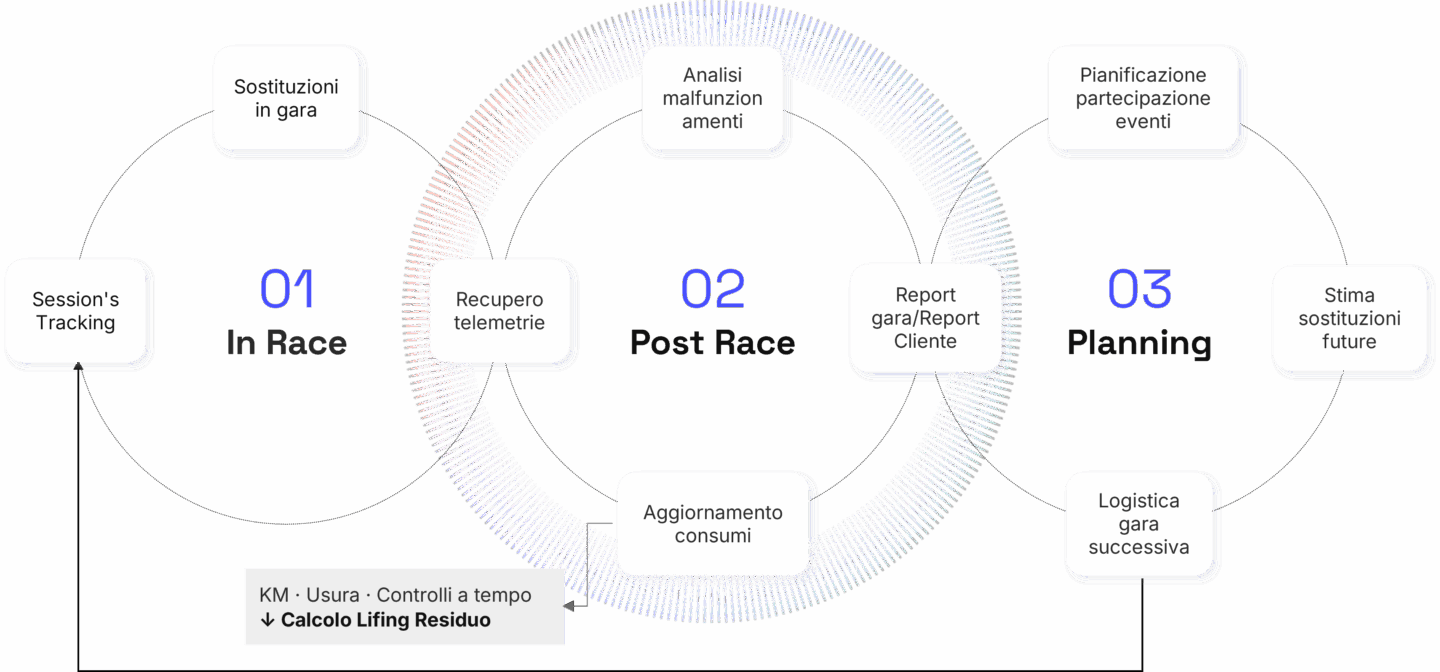
The strongest element of the project is not an isolated prediction. Rather, it is the continuous loop that links what happens during one event to the decisions the next one requires.
In race: capture what happens under pressure
During practice, qualifying and the race, the team records mileage, wear, scheduled controls and unexpected replacements. Speed matters here, but so does usability. People in the pit environment need reliable information without wrestling with spreadsheets, disconnected systems or inconsistent data structures.
Therefore, we replaced the previous Excel-based process with an adaptive interface that adjusts to the user’s role, context and task. As a result, the technology supports the work rather than slowing down the people who make operational calls.
Post-race: turn telemetry into shared context
After each event, the platform consolidates telemetry, updates actual component consumption, analyses malfunctions and generates race and customer reports. This is the moment when raw signals become a shared operational picture. Engineers, mechanics, logistics teams, and managers all work from the same information because a single, consistent data model lies beneath.
The platform also updates the remaining life of each component. For consumables and non-critical parts, it operates automatically, eliminating repetitive manual work. For critical components, however, it recommends an action and asks an expert to validate it.
Planning: decide before the next event begins
The highest-value phase looks forward. The system combines updated component lifespans with upcoming circuits, the event calendar, and expected driving profiles. It then identifies the components at greater risk, proposes pre-event replacements and supports logistics and participation planning.
The output is not another report. It is a structured decision:
- What to inspect;
- What to replace;
- Which parts to order;
- What can safely continue running;
- Who must approve the action;
- And what must happen next.
This is the point where decision intelligence for motorsport moves from monitoring to execution.
Why more AI alone would not have solved it
The project needed strong foundations before predictive models or deeper automation could pay off. Before implementation, different teams could describe or code the same component in different ways. So we started with a shared data model: common metadata, clear decision rules, and connected workflows across the complete racing cycle.
That step sounds less exciting than predictive analytics, but it is the reason the automation works. Without a common language, an organisation only automates confusion. With shared context, however, the system can connect telemetry, component history, operating conditions, business rules and expert input around the decision at hand.
This reflects a broader Natzka principle: start from the decision, not from the technology. AI is the enabler. Reliable data, shared business logic, explicit workflows, and clear governance are what make it perform well.
From data to explicit decision workflows
Traditional analytics can show component condition, historical consumption and predicted risk. Yet visibility alone does not guarantee action. A decision also needs ownership, rules and a clear path to execution.
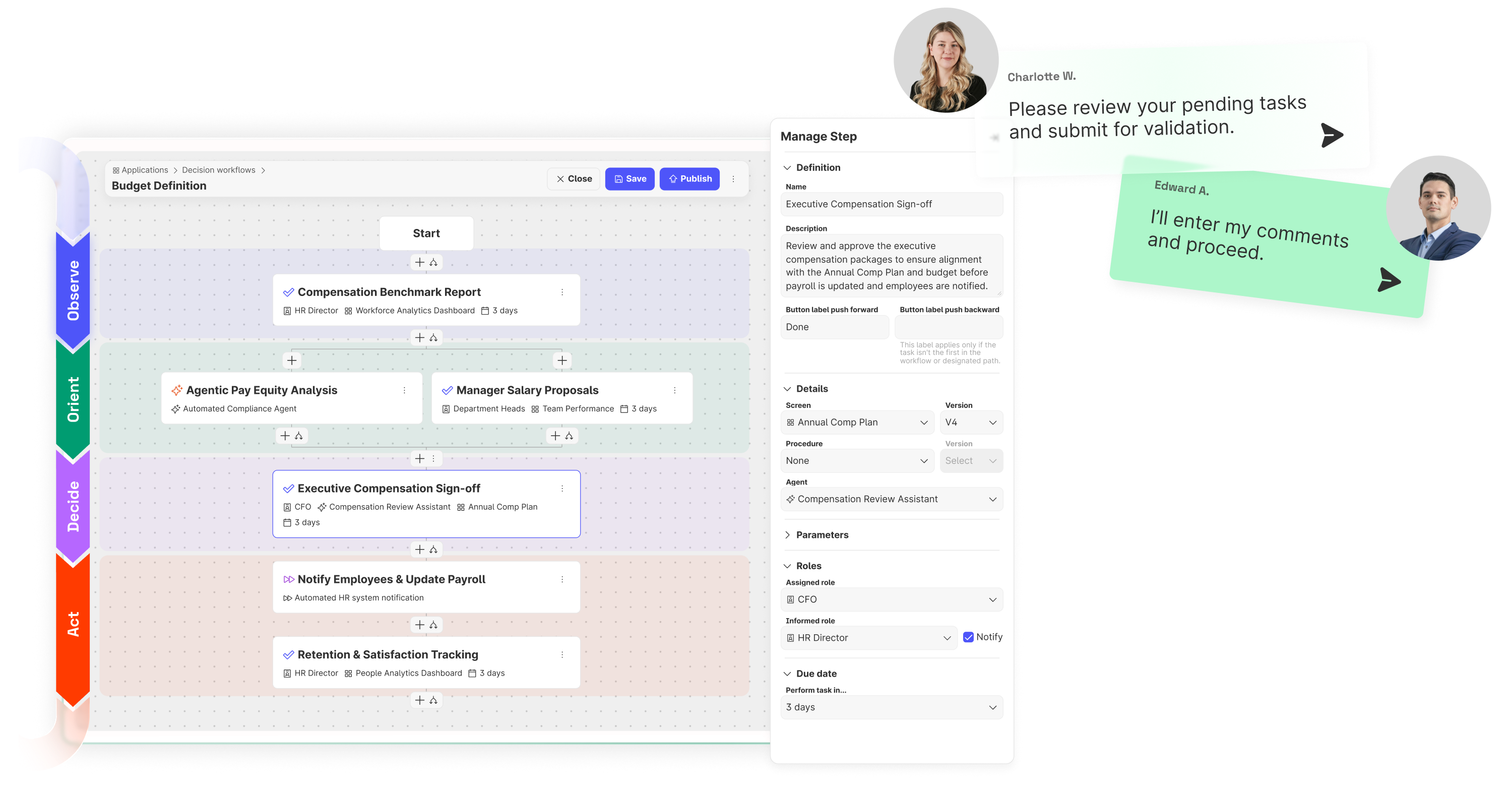
Who reviews the recommendation? Which threshold triggers a replacement? When can an action proceed automatically? When does an engineer step in? And what happens after approval? The platform makes these elements explicit. It connects the information behind the decision with the workflow that carries it out, so recommendations can flow into inspections, replacements, reporting, logistics planning or future procurement.
This is the difference between analytics and Decision Intelligence. Analytics helps an organisation understand what is happening. Decision Intelligence helps it decide what should happen next, then coordinates the resulting action.
Automation where it helps, human control where it matters
The project moved from a fully manual process to roughly 80% automation. It also cut report generation time by around 90%, bringing outputs close to real time instead of hours of post-race manual work.
The remaining human involvement is not unfinished automation but a deliberate design choice. Routine actions move faster. Non-critical replacements follow defined rules. Reports generate automatically. Safety-critical and race-critical decisions, however, still require expert validation.
This human-in-the-loop model draws a clear boundary. The platform provides speed, consistency, evidence and recommended actions. The specialist keeps judgment, responsibility and the final call. In short, the aim is not maximum autonomy but the right level of autonomy for each decision.
In this way, decision intelligence for motorsport combines quantitative inputs, such as kilometres, operating hours and telemetry, with qualitative knowledge from engineers and drivers. Instead of forcing a choice between human expertise and automation, the system lets both contribute where they add the most value.
From predictive monitoring to prescriptive action
The next stage of decision intelligence for motorsport focuses on anomalous events. Rain, accidents, impacts and unusual track conditions do not follow a clean average. Consequently, they can shorten component life in nonlinear ways that conventional models struggle to capture. The system must therefore do more than extrapolate from nominal conditions.
The direction is a more prescriptive, agentic decision-making process. When an anomaly occurs, the platform will recalculate the remaining useful life of the affected components and propose a prioritised response: what to inspect, what to replace, what to monitor, which actions are most urgent and why it recommends them. Experts will still define the operating boundaries and approve critical actions. Instead of a raw alert, however, they will receive a structured, evidence-based action plan.
A second development brings the process closer to procurement. The team will anticipate supplier requests for components approaching the end of their useful life, which extends the decision workflow into the supply chain. Together, these steps move the use case from predictive monitoring toward coordinated, agent-enabled execution.
What can enterprise leaders learn from the track?
Motorsport creates an extreme operating environment. Even so, the lessons translate well across industries because the same logic that powers decision intelligence in motorsport applies to any recurring, high-stakes decision.
Start from the recurring decision
Do not begin with the data source or the model. Begin instead by defining the decision: who owns it, which inputs matter, which rules apply, which risks count and what action should follow.
Build shared, decision-ready context
Data from different systems has limited value when teams interpret it differently. A common data model, in contrast, creates one operational reality for people and AI to work from.
Turn recommendations into explicit workflows
Insights should not end in a dashboard. They should connect to ownership, approvals, exceptions and downstream actions.
Apply AI within governed boundaries
The goal is not to automate every decision. The goal is to define where AI should support, accelerate or execute, and where expert judgment must stay in control.
Measure business outcomes
Faster reporting is valuable. The broader impact, however, comes from fewer errors, better component utilisation, stronger cost control and more reliable preparation for the next event. These are measurable operational outcomes, not just technical improvements.
Decision quality begins before the pressure arrives
The Politecnico di Milano session made Decision Intelligence tangible. The Lifing project connects telemetry, predictive analytics, business rules, workflows and expert judgment around one operational question: what should happen next? That is the difference between seeing a risk and managing it. It is also the difference between AI as an isolated capability and AI as part of a trusted operating model.
In racing, the visible result appears on the track. Decision quality, however, takes shape much earlier: when teams structure their information, clarify responsibilities, weigh scenarios and prepare the next action before the pressure arrives. That is the value of decision intelligence for motorsport.
We help organisations build the same discipline in other high-stakes environments: one shared context, explicit decision workflows, governed AI execution and outcomes that improve with every cycle.
Discover how Natzka turns data, AI and workflows into better decisions and coordinated action.