Digital Twin of an Organisation: Why CFOs Should Care

When finance teams spend days collecting data, reconciling spreadsheets and debating which number is correct, the business keeps moving. Prices change. Inventory accumulates. Demand shifts. Cash remains tied up. By the time the analysis is complete, the best moment to act may already have passed.
A Digital Twin of an Organisation (DTO) offers a different approach. Instead of viewing the business through a collection of static reports, it creates a living model of how the organisation works, connecting data, business relationships, KPIs, rules, workflows, and decisions.
That changes the question from “What happened?” to “What happens if we do this?”
And, increasingly, to “What should we do next?”
What is a Digital Twin of an Organisation?
Most people associate digital twins with physical assets: a factory, an engine, a building or a production line.
A Digital Twin of an Organisation applies a similar principle to the enterprise itself.
It creates a digital representation of how the business operates and how its different components affect one another. Products connect to customers. Customers connect to revenue. Inventory connects to working capital. Pricing decisions influence volume, margin and demand. Plans connect to actual performance.
Businesses do not operate as isolated dashboards: change one variable and the consequences can propagate across functions. Increase inventory to protect service levels and working capital changes. Adjust prices and demand may respond. Change supplier terms and cash, availability and margin can all move.
A useful organisational digital twin makes those relationships explicit.
Instead of merely reporting the state of the business, it creates an environment where teams can understand dependencies, explore scenarios, and evaluate potential decisions before acting.
This also aligns with the broader definition of a Digital Twin of an Organisation as a dynamic software model that uses operational and contextual information to understand the current organisation, respond to change, and simulate possible future states.
The real problem is decision latency
Finance teams export information from ERP systems, rebuild models in Excel, compare different versions of a forecast and reconcile numbers across departments. BI dashboards may make performance easier to see, but they do not necessarily make the underlying decision easier to execute.
This creates decision latency: the gap between recognising a change and taking the right action, and that gap has financial consequences.
A pricing decision made two weeks late can affect margin. A slow inventory response can trap cash. A delayed forecast adjustment can leave resources allocated against assumptions that are no longer true.
The objective is therefore not simply faster analytics. It is a shorter path from data to decision to action.
That is where a Digital Twin of an Organisation and Decision Intelligence begin to converge.
Decision Intelligence starts from the decision itself: what needs to be decided, what context matters, which options are available, which rules apply, who owns the decision and what should happen next.
If you want to explore that distinction further, see Business Intelligence vs Decision Intelligence: What Is the Difference?.
From static reports to a living decision model
A Digital Twin of an Organisation becomes much more useful when it is connected to current operational and financial data.
Rather than rebuilding the business logic for every analysis, the organisation maintains a shared representation of its entities, relationships, hierarchies, KPIs, and business rules.
A finance team could then ask:
- What happens to cash if we change supplier payment terms?
- How would a different product mix affect margin?
- What happens to service levels if inventory targets are reduced?
- Which regions create the greatest downside risk to the forecast?
- What is the financial impact of increasing production capacity?
- Which action gives us the best outcome under the current constraints?
The objective is not to create a perfect virtual copy of the entire enterprise.
It is to create a sufficiently accurate model of the decision context around important business questions.
That distinction matters. The value of the twin is not how impressive the visualisation looks. It is whether it helps someone make a better decision.
Simulation turns the twin into a decision tool
Once teams model the relationships that drive a business, they can begin testing alternatives.
A dashboard might tell you that stock has increased by 12%. That is useful information, but it does not tell you what to do.
A decision model can go further. Finance and operations can explore what happens if safety-stock levels change, demand falls, supplier lead times increase or a particular SKU is discontinued.
They can compare the effects on revenue, working capital, service levels and margin before committing to an action.
The same principle applies to pricing, budgeting, capacity planning, workforce allocation and many other decisions.
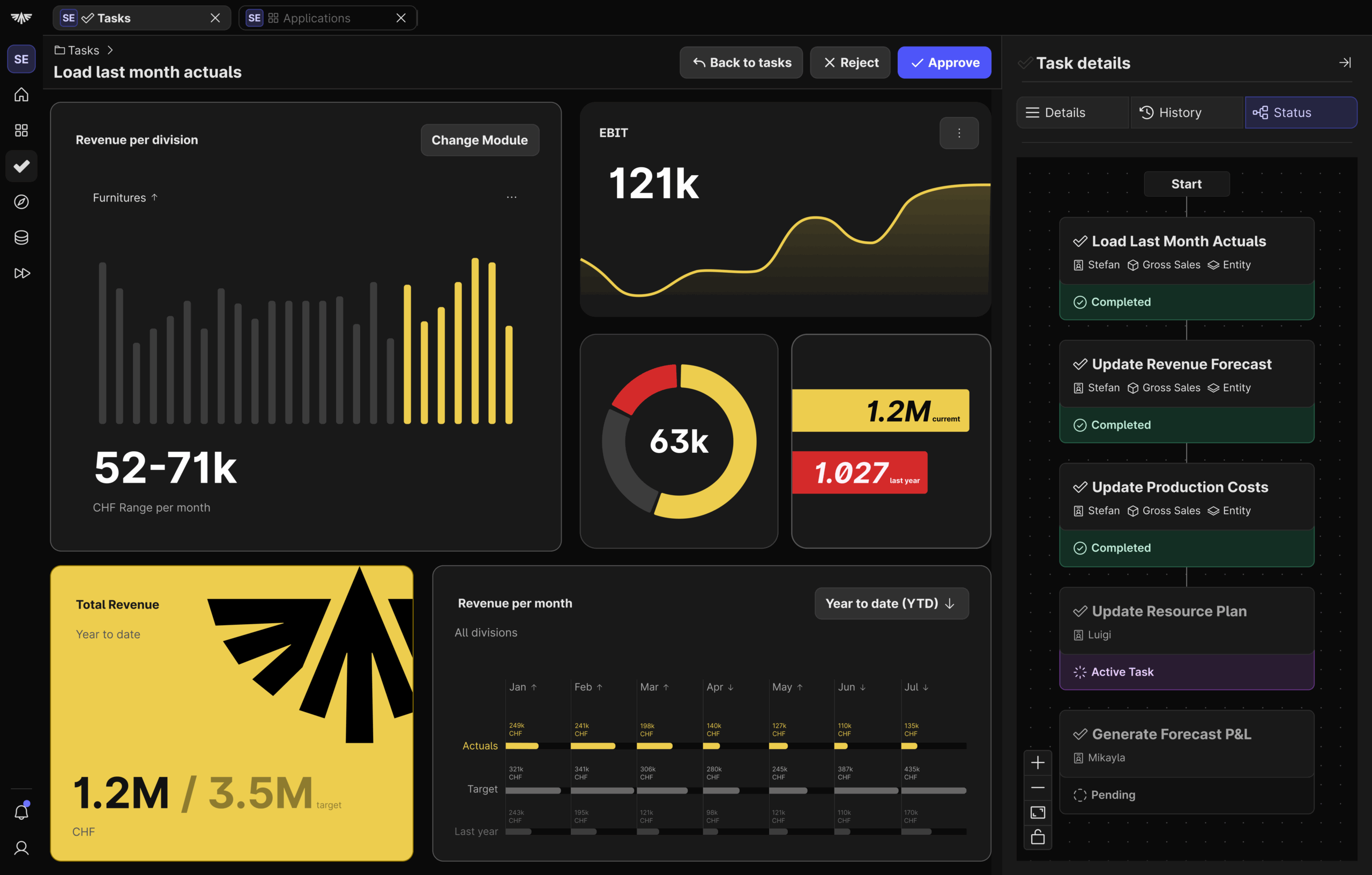
For finance teams, this can be particularly powerful in budgeting, forecasting, and scenario planning, where operational assumptions can be connected directly to P&L, balance sheet, and cash-flow consequences.
This is the point at which a Digital Twin of an Organisation stops being another reporting layer and becomes a simulation environment for the business.
From simulation to action
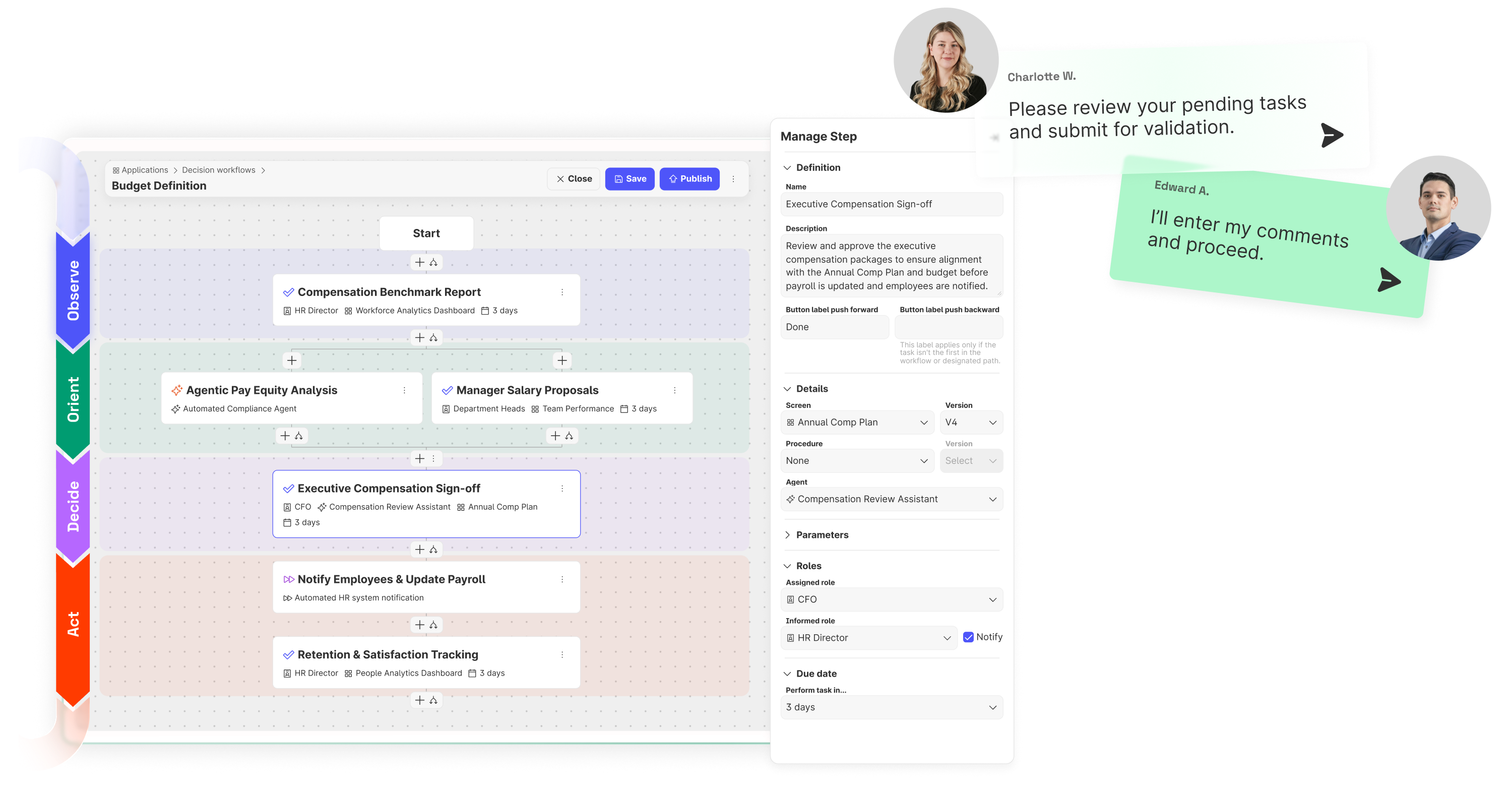
Decisions need to move into workflows. Who must approve the change? Which policies apply? Does another department need to review it? Which system should be updated? What happens if an exception occurs?
Natzka approaches this as part of a broader Decision Intelligence architecture.
The platform connects the underlying business and decision context with analysis, planning, forecasting, simulation and operational applications. Users can evaluate a situation, compare alternatives and connect approved decisions with the next action.
Decision workflows can route exceptions, request human approval, coordinate tasks and connect decisions with operational execution.
The result is a continuous cycle:
Observe → Orient → Decide → Act → Monitor
And because the decision, assumptions and approvals remain connected, teams can compare the expected outcome with what actually happened.
That closes a loop that traditional reporting often leaves open.
Why AI makes the Digital Twin of an Organisation more important
An AI model can analyse enormous quantities of information. But enterprise decisions require more than data access; they need context.
It needs to understand which KPIs matter, how business entities relate to one another, which policies constrain a decision, which actions are permitted and when a human must remain in control.
Without that context, an AI agent may know a great deal about the available data while understanding very little about the business decision it is being asked to support.
A Digital Twin of an Organisation can provide part of that foundation.
This is particularly relevant as enterprise AI moves from answering questions toward participating in business processes. As we explored in Why AI projects stall: AI needs the right foundations, AI needs trusted data, business context, rules, workflows and governance if its answers are expected to produce reliable business outcomes.
Combined with Agentic Decision Intelligence, AI can move beyond answering questions about the business toward helping people understand situations, evaluate alternatives and initiate appropriate actions.
The twin provides business context. AI helps interpret it. Decision Intelligence governs how the resulting decision moves into execution.
What does a Digital Twin of an Organisation mean for the CFO?
Faster decision cycles
Less time is spent collecting and reconciling information before a decision can be made.
Better cash and margin control
Teams can evaluate the financial consequences of operational changes before committing.
More dynamic planning
Forecasts and scenarios become part of a continuously evolving business model, not periodic spreadsheet exercises.
Better cross-functional decisions
Finance can evaluate decisions alongside their consequences for operations, supply chain, sales, or other parts of the organisation.
More traceable decisions
Assumptions, approvals, decisions and subsequent outcomes can remain connected rather than disappearing across emails, spreadsheets and meetings.
A stronger foundation for enterprise AI
AI and agents can operate against structured business context rather than isolated datasets and prompts.
A Digital Twin of an Organisation is only valuable if it helps you decide
The digital twin represents the business and its dependencies. Simulation helps evaluate possible futures. Decision Intelligence turns those possibilities into governed decisions and actions. AI increasingly helps humans navigate the entire process.
It reduces the distance between knowing and doing.
Natzka was built around that objective: connecting data, business context, analysis, decisions and execution in one environment.
Start with one recurring decision that matters financially. Define its context, model the alternatives and measure what changes when the organisation can move from insight to action faster.
Contact Natzka to explore your first high-value decision use case.