AI projects stall after promising pilots far more often than they do after scaling. The problem is what sits behind it.
AI is quickly becoming the new front door to business software. Instead of opening several dashboards, searching through reports or moving between applications, people increasingly expect to ask a question, understand what changed and trigger the next action through a simple AI interface.
AI can make complex technology easier to use. But it cannot create reliable business value from weak data, unclear logic and disconnected processes. The interface may look intelligent. What lies behind it still determines whether the answer can be trusted and whether anything useful happens next.
Why AI projects stall after the demo
In a controlled pilot, an AI model can produce an impressive answer.
Then it meets the organisation.
Data is spread across different systems. Teams use different definitions for the same KPI. Approval rules live in documents or in people’s heads. A recommendation appears in one tool, while the work required to act on it occurs elsewhere.
This is what we described in our recent TechCrunch article as the orchestration wall. AI tools are often disconnected from the data, workflows and business context behind real enterprise decisions.
The model is not always the problem. Often, AI simply has no dependable foundation from which to understand the business, support a decision and coordinate action.
AI needs something solid behind the interface
The next generation of enterprise software will be easier to access through AI.
At Natzka, that means users can tap into the platform’s core capabilities more naturally. They can ask questions about their data, explore why a KPI changed, compare scenarios, review a forecast, understand an exception or start a workflow.
But those experiences only work when AI has the right context. It needs trusted data and consistent business definitions. It has to understand rules, responsibilities, constraints and workflows. And it must know when a person should review a recommendation and when the system can execute an action automatically.
Without those foundations, AI is only producing plausible answers atop the same old fragmentation.
Foundations turn AI into an enabler
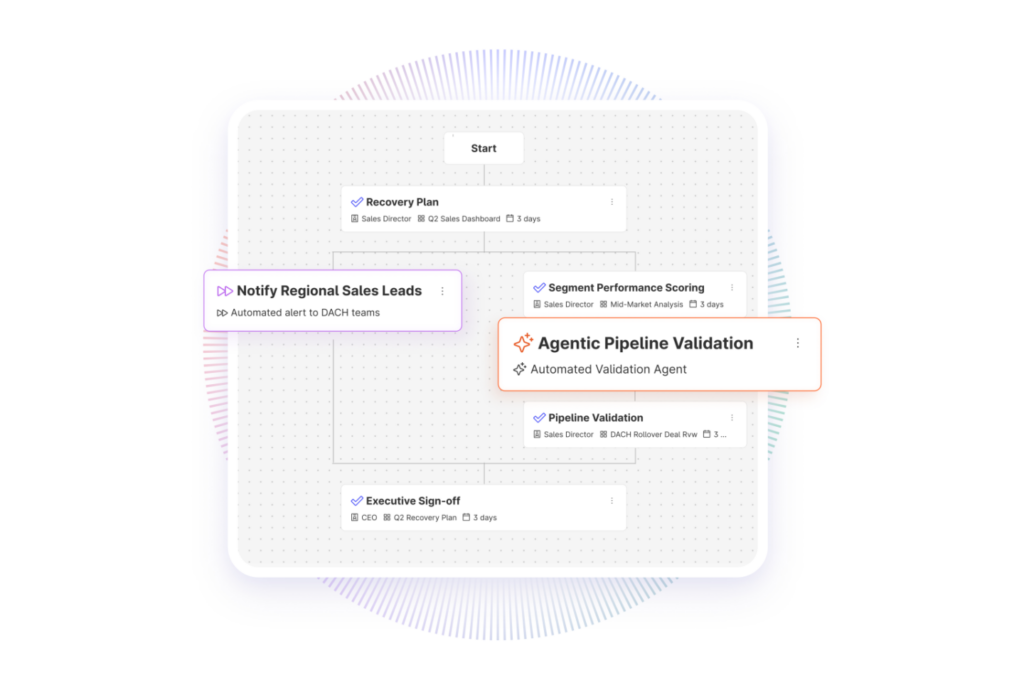
We bring data foundations, analytics, business applications, workflows, and Decision Intelligence into a single environment. AI does not sit beside these capabilities as another isolated tool. It becomes a simpler way to access and activate them.
Consider a retailer facing a sudden increase in demand. AI might identify the signal and explain what is driving it. However, to recommend a useful response, one must also understand current inventory, store priorities, margin targets, promotion rules and operational constraints.
Once the decision lands, the system must launch the right workflow, involve the right people, update the plan and preserve a traceable record of what happened. The value comes from connecting the answer to the data, logic and processes needed to act on it.
Start with what AI needs to succeed
Companies should ask what it needs to know, which decision it is meant to improve and what should happen after it produces an answer.
That means getting the foundations right: the data, the business context, the rules, the workflows and the governance.
Once those elements are in place, AI can do what it does best. It can make powerful capabilities easier to access, help people understand complex situations faster and move the business from question to decision to action.
AI is the enabler. The foundations are what make it perform. That is how enterprise AI moves beyond the demo and starts creating measurable value.
Read our full TechCrunch article, “AI projects are stalling. What’s missing is a decision-centric operating layer”, to explore why enterprise AI needs a stronger connection between intelligence, decisions and execution.
Or contact us to learn more.