Decision Intelligence: Where Content Becomes Value
In Fashion and Luxury, the core challenge is not merely better content production. It is using Decision Intelligence to turn content into business decisions that improve time, cost, quality, and return on investment.
Across the sector, digital content is now a fundamental part of product value. It shapes how a product is perceived, presented, and made available across channels.
Images, videos, descriptions, metadata, 3D assets, and localised content drive desirability, brand consistency, and digital performance. Every product’s digital identity now demands the same discipline as a physical supply chain.
From content production to Decision Intelligence
This evolution positions the Digital Content Factory as a vital strategic lever. The focus must shift from increasing production volume to the content that generates the most value and to understanding how resource and workflow decisions directly affect ROI.
Many companies have systems, data, workflows, and dashboards. However, the real issue is not the abundance of information. It is whether organisations use that information to consistently make faster, better decisions.
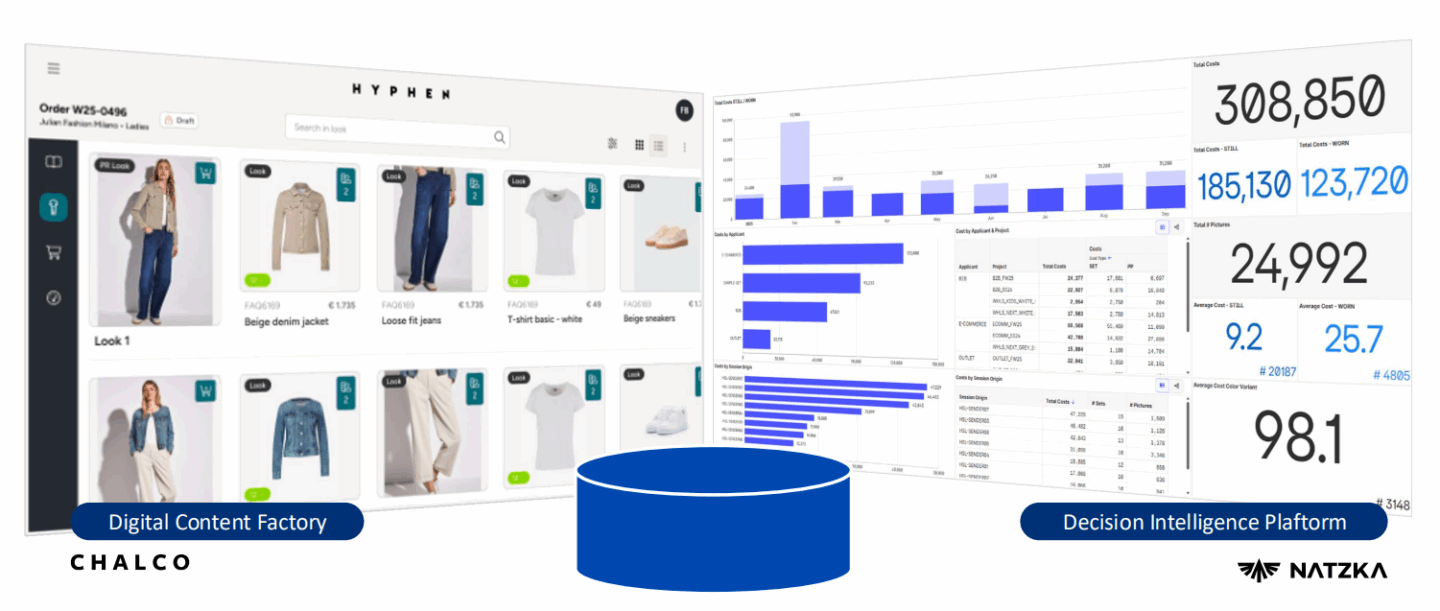
This is also the need behind the collaboration between Hyphen-Group and Natzka, which brings Decision Intelligence into the Chalco ecosystem and introduces a new approach to one of the most relevant processes in contemporary Fashion and Luxury.
Hyphen-Group brings Chalco’s experience in managing content production and distribution. Natzka adds a Decision Intelligence layer, connecting Content Factory data with other enterprise systems and turning KPIs and workflows into a shared foundation for better decisions.
The objective is to connect data, processes, and business logic, transforming information into operational, measurable decisions and placing decision quality at the centre of the value created.
When the Digital Content Factory becomes a decision problem
Measuring what you do is as important as doing it. Key Performance Indicators are not just numbers. They are essential tools for managing and controlling business performance.
In the Digital Content Factory, KPIs track essential dimensions: effort, elapsed time, productivity, quality, efficiency, and time-to-market. They reveal whether the digital factory is working, where delays occur, which activities require more resources, and which processes can be improved.
When content production becomes a material cost item and a competitive driver, measurement must guide strategic choices: where to intervene, what to optimise, and which decisions carry the greatest impact.
Yet many companies are rich in data and dashboards, while their decisions remain scattered and reactive. This gap between measurement and tangible improvement underscores the need for robust decision models that translate information into strategic action.
In a mature Digital Content Factory, the questions get sharper. Which assets deserve investment? Do certain formats perform better across channels, and which content accelerates launches? Where does the process create inefficiency, and which decisions could improve the next season?
Ultimately, these questions show where concrete decisions beat simple monitoring. The core issue is not a lack of data. Instead, it is the absence of a structured decision model that drives measurable business impact.
Connecting data to decisions
In Fashion and Luxury organisations, content data is often scattered across systems: asset management platforms, production workflows, e-commerce, marketing, sales, product data, and finance.
The challenge, then, is connecting that data to decisions. Isolated data shows only activity. Connected data, read in context, signals priorities, risks, opportunities, and the actions to take.
This is where Natzka starts: from decisions, not from data.
The traditional approach starts from data, builds dashboards, sparks discussion, and ends with manual decisions. As a result, it misses a key point: who decides, by what rules, and through which actions.
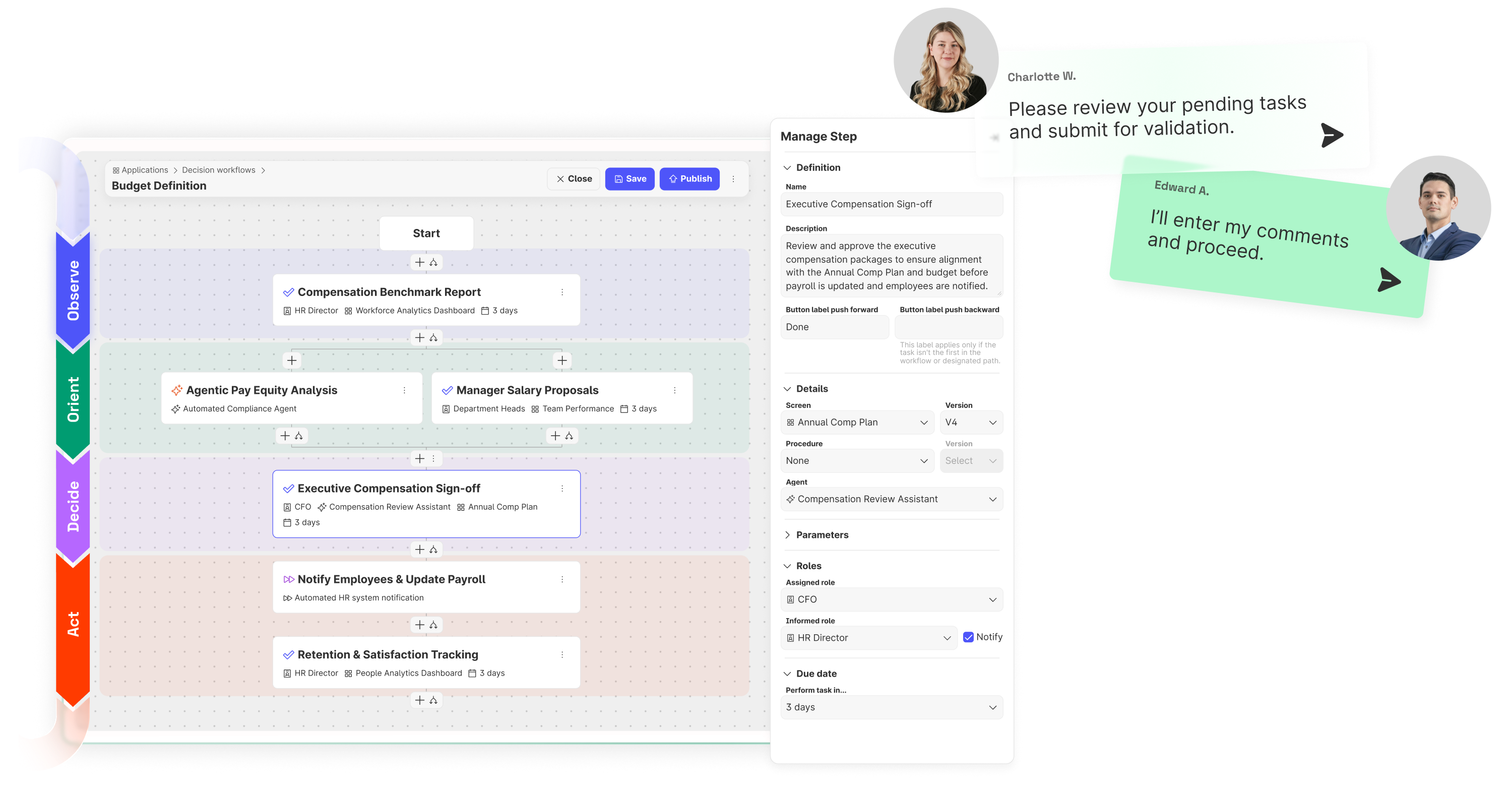
A decision-first approach reverses this logic. It first identifies the key decisions, then models the workflow, and only then connects data, analytics, and AI to a clear action path.
In practice, Natzka clarifies decisions that are usually dispersed across systems and meetings. It defines decision-makers, relevant KPIs, the rules to follow, the exceptions that require approval, and the actions required, moving a process from monitored to governed.
Applying Decision Intelligence to the Digital Content Factory, therefore, means going beyond volume monitoring. It becomes essential to understand which content contributes to results, which delays hurt most, and where investment creates competitive advantage, so the process is truly governed by decisions.
The crucial difference between observing and governing a process lies in converting data and analysis into decisions that are clearly assigned, measurable, and continuously improved. True governance makes decision-making central to the process’s value.
From workflow to value
A modern Digital Content Factory works on three levels.
The first level is the content assets: what content exists, where it sits, and how it is organised and distributed. The second is the process: who produces what, the timing of each stage, where friction emerges, and which activities absorb the most resources. The third is value: how content affects time-to-market, quality, performance, conversion, cost, and ROI.
At this third level, Decision Intelligence becomes decisive. Value emerges only when data is connected, interpreted, and turned into a common foundation for action.
With Natzka, Digital Content Factory data becomes a decision lever. Teams can assess scenarios, set priorities, anticipate issues, activate workflows, and increase the traceability of decisions.
The digital factory thus evolves from a production system into one that learns from its own cycles, corrects inefficiencies, and maintains consistent, strategic decision-making across seasons.
The role of AI: Ask, Explain, Act
AI is useful only when it sits inside clear decision processes. Adding it to fragmented data, poorly managed workflows, or vague responsibilities only increases confusion.
For Natzka, AI applied to Decision Intelligence creates value on three levels: Ask, Explain, Act.
Ask lets users query data and models in natural language, without technical queries or long handovers. In the Digital Content Factory, that can mean asking which categories require the most effort, which collections are delayed, or which assets matter for a specific channel.
Explain reveals what sits behind a KPI. A metric is never just a number. Tracing the drivers and data behind an indicator shows why a result changes and which factors truly matter.
Act connects analysis to action. When a process crosses a critical threshold or requires approval, the system activates the workflow, engages the appropriate roles, and tracks the outcome.
This is the difference between AI as an experiment and AI as an operational capability. The first often remains an interface or a promise; the second operates within the business context, follows precise rules and roles, and turns questions into tangible action.
In Fashion and Luxury, where speed, quality, and consistency must align, this matters. AI does not create value simply by answering well. It creates value by helping organisations make and execute better decisions within clear, governed boundaries.
Why this matters for Fashion and Luxury
The quality of the digital experience directly shapes how a product is perceived, presented, and purchased. A collection may be excellent, but if its content arrives late, incomplete, inconsistent, or ill-suited to different channels, its commercial value suffers.
By contrast, a well-governed Digital Content Factory accelerates time-to-market, improves brand consistency, optimises resources, and sharpens responsiveness. That, in turn, lifts sales, reduces operational costs, and sustains competitive differentiation.
For technology teams, this delivers a unified, reliable data foundation for robust AI applications. For operations, it anticipates bottlenecks, smooths workflows, reduces friction, and strengthens collaboration. For those managing investment and performance, it allows more strategic resource allocation and positions content as a driver of efficiency, differentiation, and ROI.
As complexity grows each season, better decisions are not an abstract advantage. They are necessary to protect margins, accelerate execution, reduce rework, and sustain performance.
The Digital Content Factory as a decision system
A mature Digital Content Factory is not measured by production speed or output alone. It is defined by its ability to drive better organisational decisions, from budget allocation to the correction of inefficiencies and the improvement of future strategy.
The collaboration between Chalco and Natzka shows how this approach applies to one of the most strategic processes in contemporary Fashion and Luxury. But the principle is broader: every recurring, costly, cross-functional process can become a more governed, traceable, and improvable decision system.
The challenge is not only to produce digital content. It is to understand which content generates value, which decisions make it more effective, and how to turn the digital factory into a real lever for growth, efficiency, and confidence.
The Digital Content Factory is no longer just a production machine. It is a decision system and, like every decision system, its value depends on the quality of the choices it produces.
This is where Decision Intelligence creates value: not by adding intelligence around the process, but by bringing it into the decision itself.
Want to see how Natzka can turn your data, KPIs, AI, and workflows into better decisions?
Contact Us and Discover how Decision Intelligence can support your Digital Content Factory and connect content production to the results that truly matter.