Ferrari Competizioni GT Partnership: 7 Media Highlights
Seven publications covered the Natzka Ferrari Competizioni GT partnership over the past month, each from a different angle. Together, they saw Decision Intelligence becoming an enterprise software discipline, predictive AI moving into operations, and human expertise working with technology in an environment where every decision affects performance.
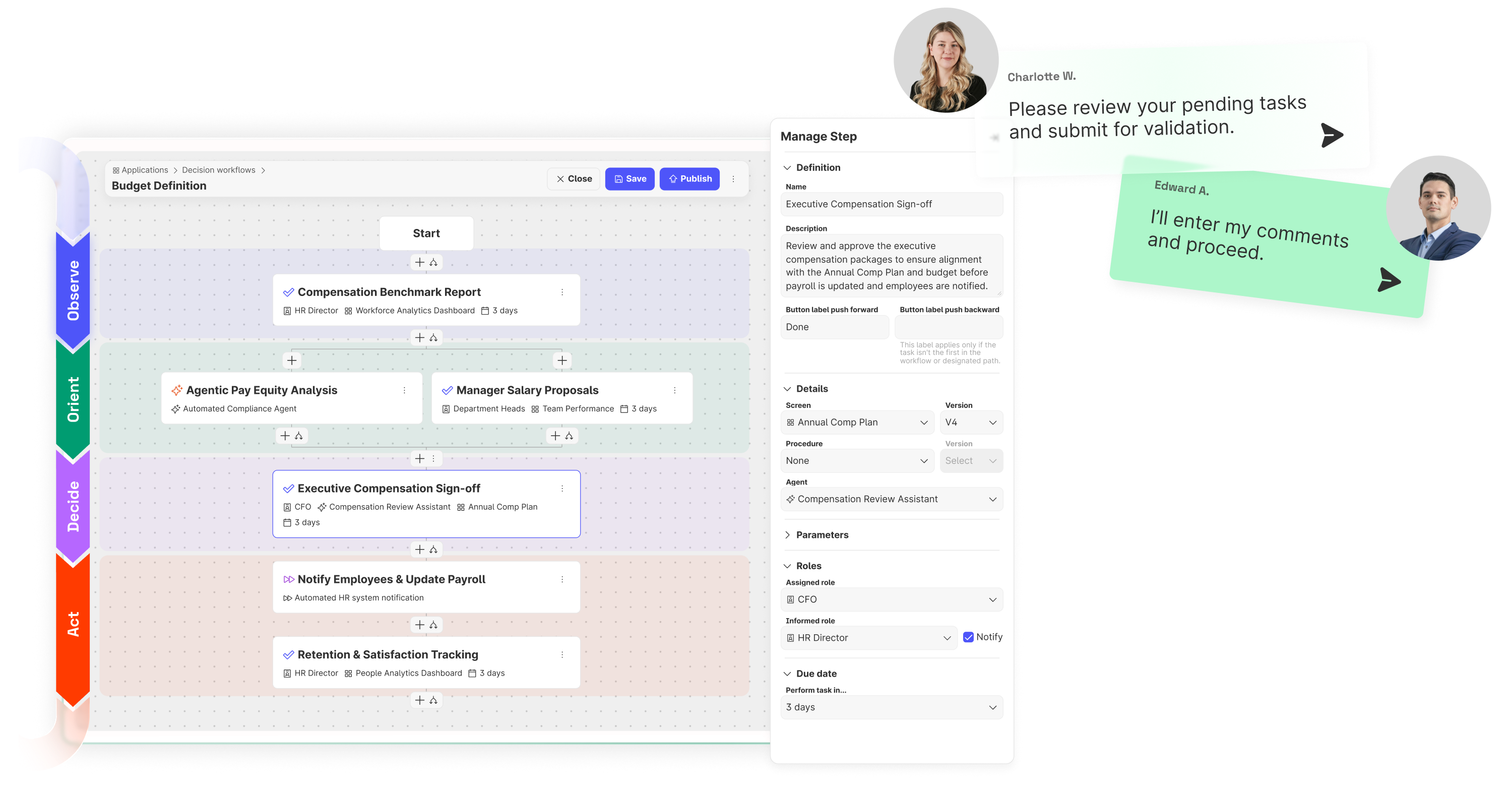
Our platform connects data, AI, workflows, and human expertise so organisations can make, govern, and execute better decisions. The Ferrari Competizioni GT partnership makes that proposition visible in one of the world’s most demanding performance environments.
Here are the seven highlights that best explain why.
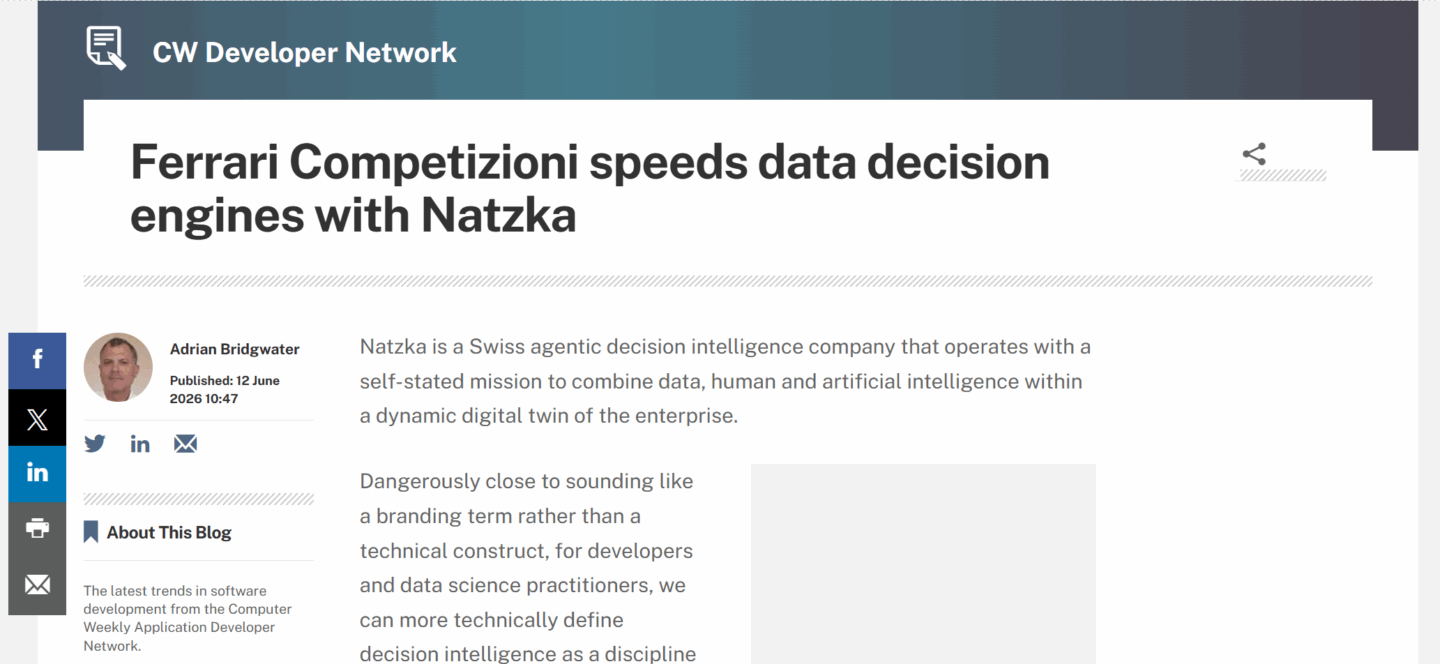
1. ComputerWeekly: Decision Intelligence is an enterprise software discipline
Rather than treating Decision Intelligence as another software label, the article defined it as a discipline that combines data management, machine learning, and human judgment. It also connected Natzka with the three levels of the category: decision support, decision augmentation, and decision automation.
Traditional analytics explains what is happening. Decision Intelligence structures the context, rules, risks, responsibilities, and actions around a decision. For Natzka, this is category validation: our platform is built to help organisations decide and act, not simply to produce more insights.
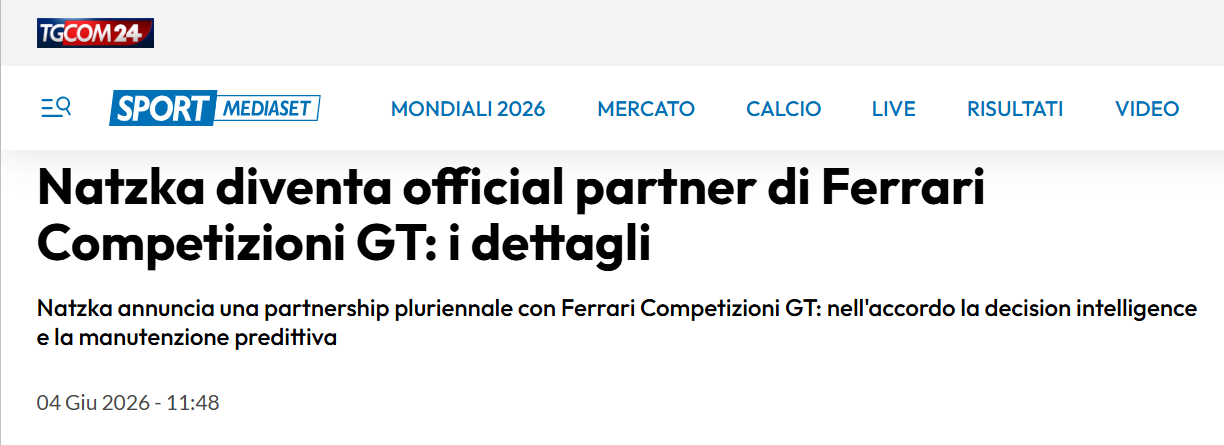
2. SportMediaset: Performance is built before it becomes visible
In GT racing, the result is created long before the car crosses the finish line. Data, timing, reliability, and human judgment come together earlier, when teams prepare, assess risks, and choose how to act.
Business performance follows the same logic. Revenue, margin, and efficiency are outcomes of decisions made much earlier across the organisation.
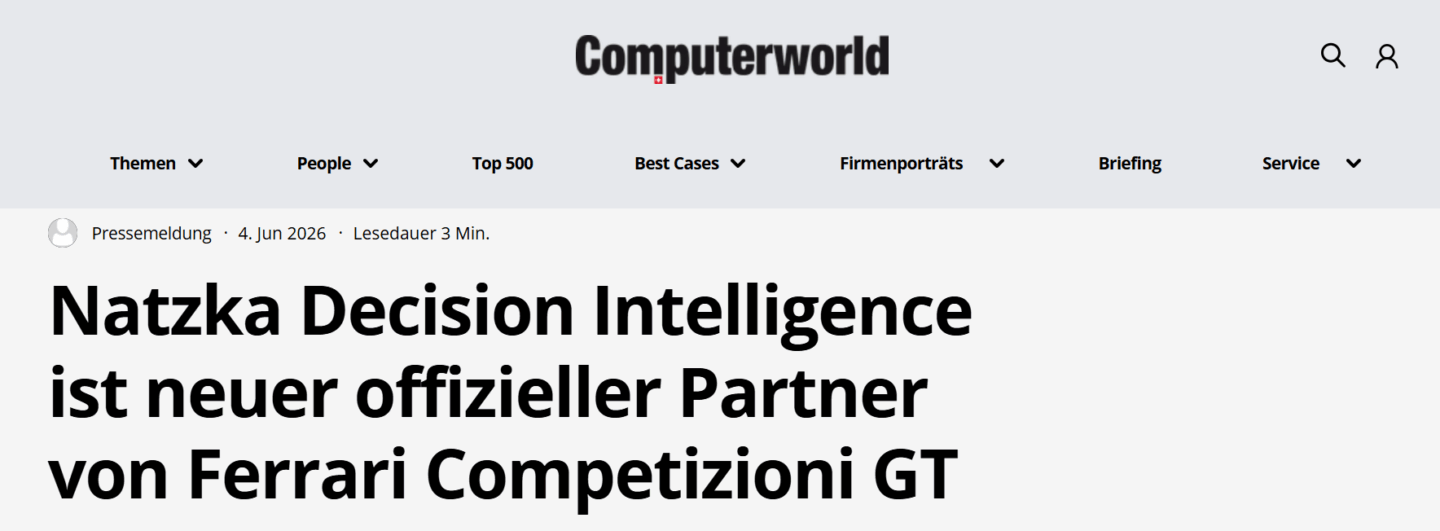
3. Computerworld Switzerland: A complex category becomes tangible
The coverage linked Ferrari Competizioni GT with engineering culture and operational discipline, and described the partnership as an environment where Decision Intelligence becomes tangible.
The category can sound abstract on its own. It becomes clear that where data must support a real decision, the decision must trigger action, and the outcome can be measured. The racing context is distinctive, but organisations in manufacturing, finance, fashion, and energy share the same challenge.
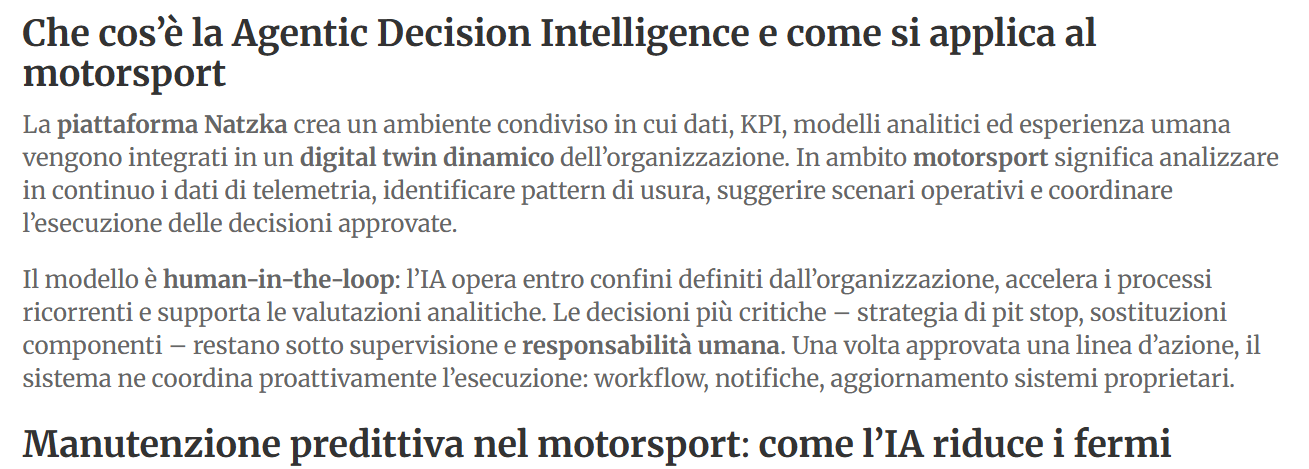
4. Tecnelab: Predictive AI must lead to operational action
The article described the racetrack as an extreme testing environment for predictive maintenance and explored how data, analytical models, and human expertise work together within a dynamic digital twin.
Its strongest point: predictive AI does not create value by identifying a signal. A useful system explains what the signal means, assesses its impact, suggests actions, and coordinates execution after approval. That is our product vision: moving organisations from awareness to assessment, decision, and coordinated execution.
5. IT Boltwise: Decision Intelligence bridges analytics and execution
The article described Natzka as a bridge between analytics and execution, in contrast with traditional BI environments where users spot patterns but still rely on meetings, emails, and manual processes to act.
Many organisations already have dashboards and AI models, yet their decisions remain fragmented across people, systems, and workflows. Decision Intelligence adds the missing operational layer: business logic, responsibilities, approvals, workflows, and writeback.
6. Capitalist: The partnership supports Natzka’s growth in Italy
The article connected three elements: the Ferrari Competizioni GT partnership, the opening of our Milan office, and our relationship with the Data and Decision Intelligence Observatory at Politecnico di Milano.
Italy combines strong industrial, manufacturing, fashion, and financial ecosystems in which decisions span functions, systems, and organisational boundaries. Our expansion brings the platform closer to companies that need a single environment for data, AI, specialised knowledge, and execution.

7. BitMAT: AI creates value when people remain accountable
The article explained our human-in-the-loop approach: AI can analyse information, propose scenarios, and automate selected activities, while people retain responsibility for the most critical decisions.
Some decisions need better collaboration and structure. Others benefit from predictions and recommended actions. Routine, high-volume decisions can run automatically within governance boundaries. Natzka supports all three levels. The goal is not to remove people from the process. It is to give them clarity, context, and control at scale.
Where can I learn more? Explore the Natzka Decision Intelligence Platform, read the official partnership announcement, or contact our team to discuss a proof of concept.