Everyone Says They’re Data-Driven. The Numbers Say Otherwise
Why most data projects stall before they ever reach a decision, and what comes after the dashboard.
Nearly every large company claims to be data-driven: it’s in their strategy slides, annual reports, and the justification for data lakes, warehouses, and countless dashboards glowing on screens across the office.
Then look at who actually uses any of it.
For years, industry research has put business intelligence and analytics adoption at somewhere between 20% and 35% of employees. Roughly one in four people touch the data their company spent millions to collect. More striking still, that number has barely moved across two decades of new tools, new platforms and new waves of enthusiasm. The technology keeps changing. The adoption rate does not.
That gap is what we explored in a recent podcast conversation. The answer we found is uncomfortable because it highlights the role of the company mindset rather than software alone.
The wrong first question
When a company decides to “get serious about data,” it usually starts by asking what data it should collect. The question travels straight to the IT department, which responds the way IT departments do: with pipelines, infrastructure and a place to put everything.
Although this appears to be progress, it often is not.
The better question is almost never asked first: what decision are we actually trying to improve? Without that anchor, a company can build a technically flawless system that no one has a reason to open. Infrastructure without a decision model on top of it is just very expensive storage.
This is a deceptively simple reframe. Many data strategies are built from the ground up, prioritising infrastructure over the people who use it. The technical systems grow more advanced, while people continue to rely on Excel.
The layers that lead nowhere
The typical journey looks orderly on a diagram. First, a data lake, where everything lands, often unorganised. Then, a data warehouse, which structures the data so it can be queried, but only by people who know how to write SQL. Then a layer of dashboards and reports, finally bringing numbers within reach of managers and analysts.
Each layer is real work. Each is defensible. And yet the destination is almost always the same: a screen that tells you what already happened.
This is the quiet limitation of the dashboard era. Dashboards describe the past. They are excellent at it. What they cannot do is let you ask the question that decisions actually require: what happens if? What happens to demand if I raise prices by 5%? How much more do I need to order? What does that do to storage costs, to margins, to the customers who quietly walk away? A dashboard has no answer. It was never built to have one.
From describing the past to testing the future
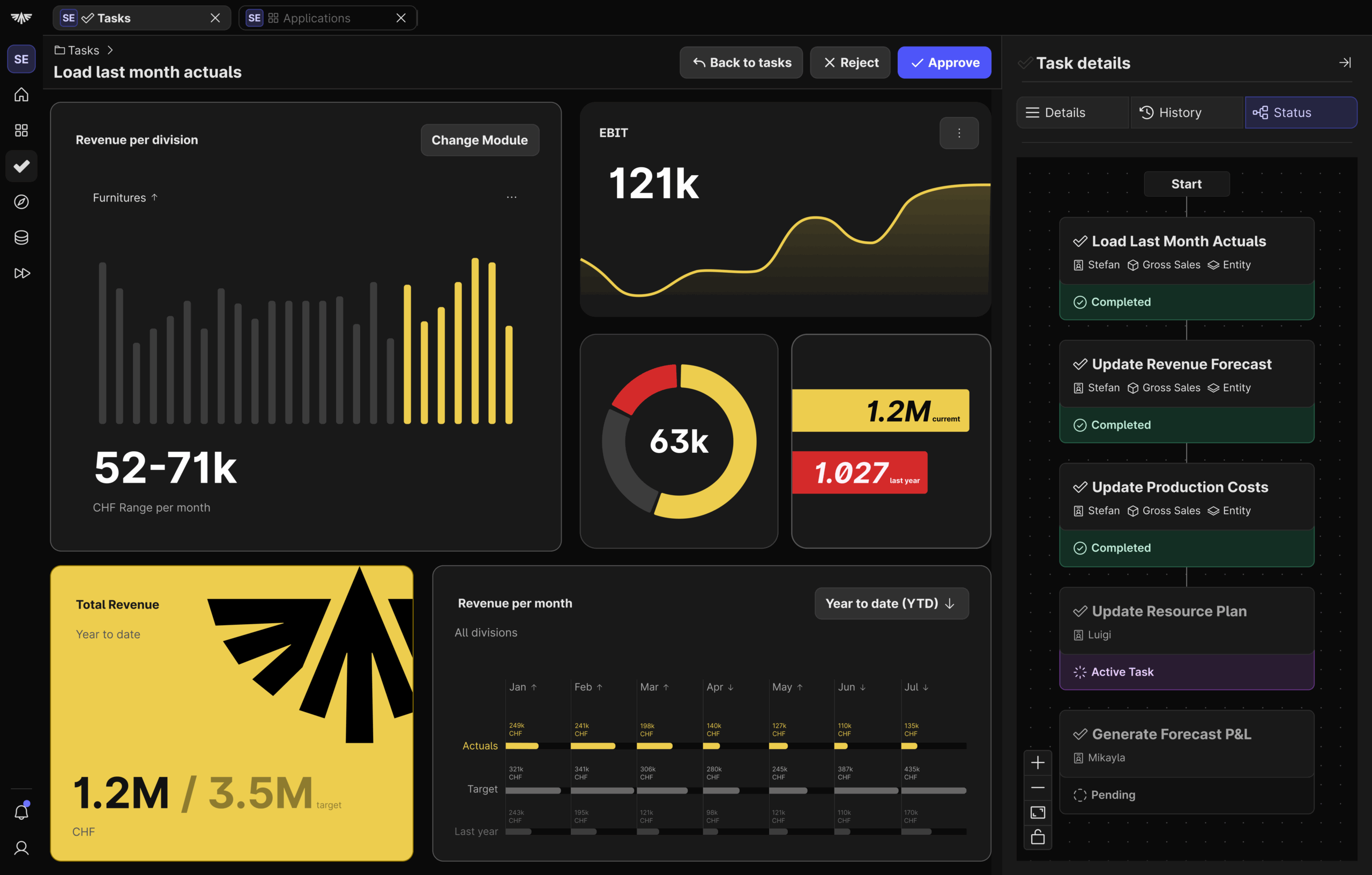
This is where we place our bet. We are, in effect, building a digital twin of an organisation: a working model detailed enough that a manager can test a decision before committing to it.
The promise is a shift in posture. Instead of reviewing what happened last quarter, an executive can simulate next quarter. Push the price up. Watch demand, churn, margins, stock levels and operations respond in the model. Then decide. The data stops being a rear-view mirror and starts behaving like a steering wheel.
That is the heart of what the industry has begun calling decision intelligence: connecting data, analysis and workflow around the choices that move the business, rather than around the act of storing information.
The unglamorous truth underneath
None of this works if the underlying data is a mess, and it almost always is.
Behind polished ERP systems that keep transactions running smoothly, true planning often resides in what is effectively “Excel hell”: numerous spreadsheets, partly system-loaded and partly manually entered, circulated as email attachments with names like version 3 final final. Critical processes such as financial closings, product launches, and forecasts often lack proper governance.
So the work is unglamorous. In our experience, around 80% of a project is spent cleaning and structuring data before a single decision can be modelled. Garbage in, garbage out is not a slogan here; it is the budget.
One concept does most of the heavy lifting: the semantic layer. In a spreadsheet, a formula points to a cell — A1, B2 — and breaks the moment anything moves. A semantic layer points to meaning instead. “Revenue” always means revenue, wherever it lives. Build calculations on concepts rather than cell references, and the fragile machinery underneath stops shattering every time the data shifts. Just as importantly, people who will never learn SQL can finally serve themselves.
Where the real work begins
The deeper implication here is not about software. If data becomes genuinely accessible — if a manager can model a pricing decision without routing it through a controller or an analyst — the traditional gatekeepers of information start to look different. That is less a technology question than an organisational one.
It does not mean dissolving the controlling department or sidelining outside expertise; both still carry hard-won judgment. It means ownership has to move. The person who owns a decision has to drive the data behind it. Top-down strategy and bottom-up infrastructure have to meet in the middle.
Which is why the adoption problem will not be solved by the next platform if the starting question does not change. Before funding the next data initiative, name the repeatable decisions it is meant to improve. If you can’t, you are funding storage. The advantage will not go to whoever collects the most data. It will go to whoever decides better, faster and more transparently with the data they already have. In most industries, that is the difference that compounds.
For more information or inquiries: https://www.natzka.com/contact-us/

Listen to the podcast here:
Spotify: https://open.spotify.com/episode/31Uy2ZyiRP58PyE1gpBEDV
Apple Podcasts: https://podcasts.apple.com/de/podcast/das-palantir-playbook-wie-das-schweizer-startup-natzka/id1494839760?i=1000771622254